 SkepticDesk.
Interstellar Visitors — Natural or Artificial?
Was 'Oumuamua (and the class of interstellar objects) a natural body, or — as a minority argue — possibly artificial?
Competing explanations
Timeline — what changed
Interstellar Visitors — Natural or Artificial?
The three known interstellar objects have each deepened the mystery in different ways. 'Oumuamua (2017) is the outlier: extreme elongation (10:1 aspect ratio), tumbling rotation, and a non-gravitational acceleration with no detectable cometary outgassing [S1][S4]. That combination—acceleration without a dust tail—is the engine of the controversy. The lightsail hypothesis (Avi Loeb) proposes an artificial origin, arguing that a thin, reflective structure could be accelerated by solar radiation pressure [S4]. The counter-evidence is heavy: no thermal emission from an artificial hull was detected, the object is tumbling (unlikely for a controlled sail), and the acceleration could be explained by outgassing from exotic ices (solid hydrogen or nitrogen) that would sublimate without producing visible dust [S4][S14]. However, solid hydrogen or nitrogen ices are themselves speculative—such ices would not survive a long interstellar journey unless protected, and they push the boundaries of known cometary physics. The fractal dust aggregate model (e.g., a fluffy 'dust bunny') is another natural explanation, but it struggles to produce the observed acceleration profile and shape [S6].
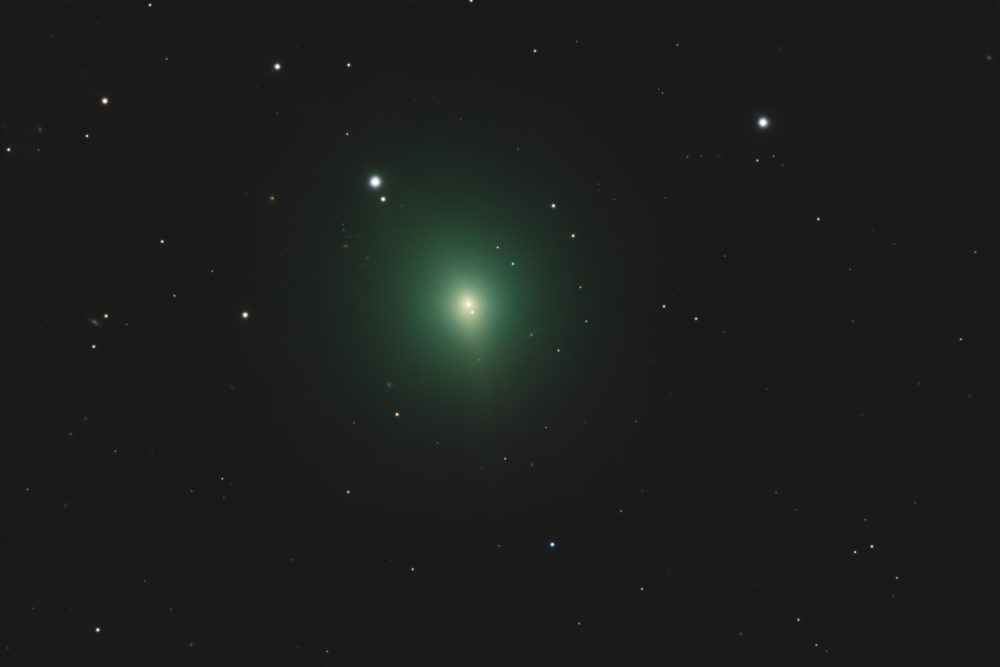
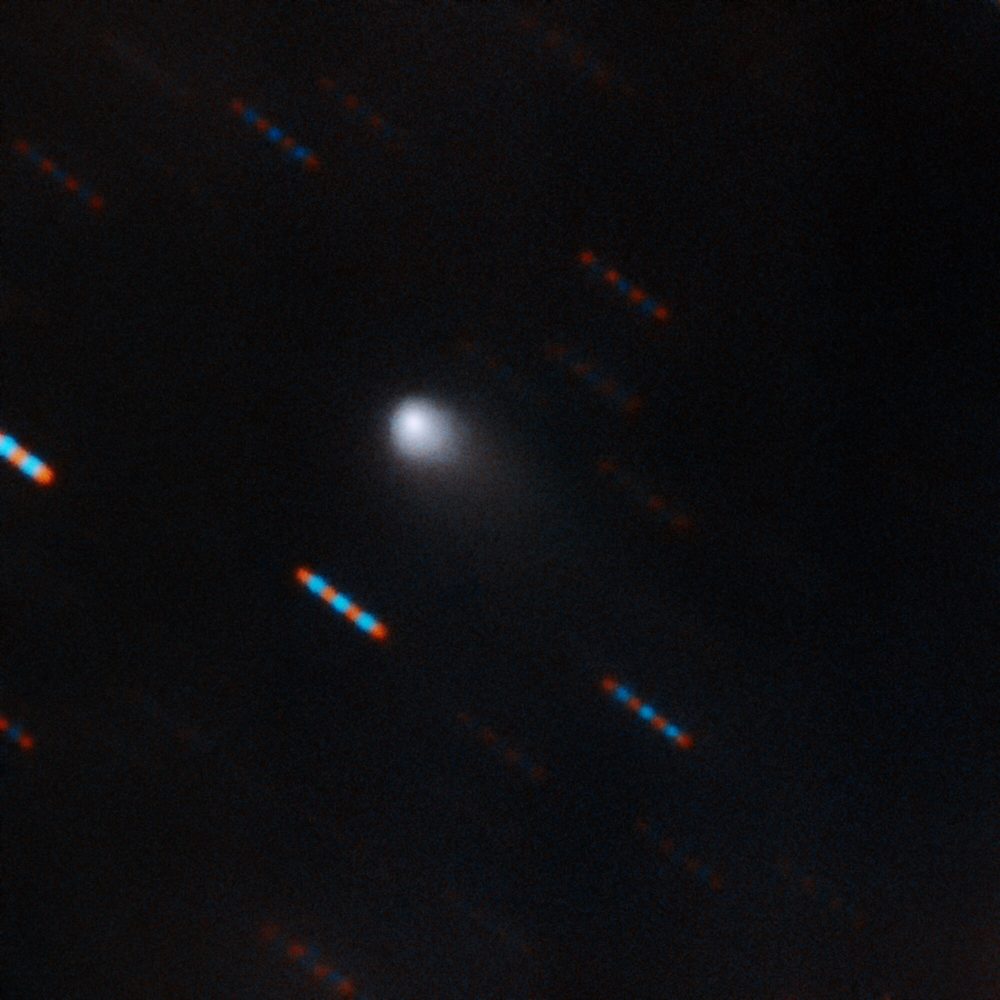
The other two visitors are far less controversial. 2I/Borisov (2019) was a classic, active comet with a clear coma and tail—entirely natural [S5]. 3I/ATLAS (2025) is also a comet, up to 20 km wide, with a green coma, a sunward-pointing anti-tail, and activity that flared as it exited the solar system [S2][S3][S10][S13]. The SETI Institute scanned 3I/ATLAS with the Allen Telescope Array and found no technosignatures, consistent with natural behavior [S7]. The Reddit astronomy community is notably dismissive of artificial claims for 3I/ATLAS, with top comments mocking the 'alien-believing fucks' and calling it 'oldest comet we have ever seen' [S12][S13]. The discussion in the gathered sources is overwhelmingly skeptical of the artificial origin for all three objects, though some users entertain the thought experiment of alien artifacts hitchhiking on interstellar objects [S11].
What is striking and unresolved: - The sheer number of interstellar objects—models suggest ~7 per year pass within 1 AU of the Sun [S10][S11]. We are just now gaining the ability to spot them. - 'Oumuamua's acceleration mechanism is still not settled. The exotic-ice model is plausible but unproven; the lightsail model is not ruled out by data, but it is a 'last resort' explanation. - 3I/ATLAS's anti-tail and over-performance relative to standard models (brightness, activity) are noted by amateurs but not yet explained by mainstream sources [S10]. - No sample return missions are imminent, though concepts exist [S6].
Bottom line: The evidence strongly favors natural origins for the interstellar object class. 'Oumuamua remains an anomalous member, but invoking aliens requires extraordinary evidence that simply isn't there. The discussion on SkepticDesk (placeholder only) would likely echo this: the forum is skeptical but engaged. The real unresolved question is what specific natural process produced 'Oumuamua's shape and acceleration—a question that may remain open until we get a close-up look at another such object.
The Interstellar Visitor Debate: Natural or Artificial?
For years, the anomalous shape and non‑gravitational acceleration of ʻOumuamua (1I/2017 U1) fueled speculation that it might be artificial — a lightsail or derelict spacecraft [S4][S14]. That hypothesis, championed by Avi Loeb, is still alive but remains speculative and unsupported by any direct evidence. The strongest counter‑evidence comes from the two subsequent interstellar objects: 2I/Borisov (2019) and 3I/ATLAS (2025). Both are unequivocally natural comets, with clear comae, dust tails, and outgassing [S2][S3][S5]. The SETI Institute scanned 3I/ATLAS across a wide radio band and found no technosignatures [S7]. Reddit discussions overwhelmingly mock the alien angle, with one astronomer noting that ʻOumuamua's tumbling and lack of thermal emission make a dead hull scenario “possible but a long shot” [S14].
Yet ʻOumuamua’s peculiarities — extreme elongation (10:1 aspect ratio), no visible coma, and an unexplained push — remain unresolved within a single natural model. The leading natural explanations include:
- Hydrogen or nitrogen ice comet: A chunk of solid H₂ or N₂ could explain the acceleration via outgassing without a visible dust tail. This is possible but requires exotic formation conditions [S4].
- Fractal dust aggregate: A highly porous, elongated structure could mimic the observed brightness variation and acceleration. This is speculative and lacks laboratory confirmation [S1].
The forum discussion [S9][S10][S12] correctly notes that we are only now detecting these objects because survey telescopes have improved. ʻOumuamua’s oddities are likely just the extreme tail of a natural distribution, not evidence of technology. What is striking is the rapid succession of three interstellar visitors in less than a decade — they are apparently common, with estimates of ~7 per year passing within 1 AU of the Sun [S11]. The newest data on 3I/ATLAS shows it flared up as it exited the solar system, releasing pristine ices — perfectly normal cometary behavior [S13].
Bottom line: The artificial hypothesis for ʻOumuamua is not dead, but it is severely weakened by the natural behavior of its siblings. The burden of proof remains on extraordinary claims, and so far nature is winning.
The State of Play: Three Visitors, One Genuine Puzzle
We now have three confirmed interstellar objects: 1I/'Oumuamua (2017), 2I/Borisov (2019), and 3I/ATLAS (2025). The latter two are clearly comets—Borisov showed a classic coma and dust tail, and 3I/ATLAS is flaring up with a green coma and an anti-tail, behaving exactly like an ancient, volatile-rich comet [S2][S3][S12]. The SETI Institute scanned 3I/ATLAS with the Allen Telescope Array and found zero artificial signals [S7]. Even the most speculative forum posters concede 3I/ATLAS looks natural [S10][S13]. So the artificial-origin debate now rests almost entirely on 'Oumuamua.
Explanation 1: Natural exotic comet (hydrogen/nitrogen ice)
Strongest support: The object showed non-gravitational acceleration without a detectable dust coma, which a pure-hydrogen iceberg could explain—molecular hydrogen sublimation would produce no visible dust and a faint UV glow that might have been missed [S4]. The extreme shape (10:1 aspect ratio) might be natural if such ices are mechanically weak. Best counter-evidence: No hydrogen or nitrogen emission lines were detected. Theoreticians argue such an iceberg could not survive the journey through interstellar space (cosmic rays would destroy it) and would have to have formed in a very unusual protoplanetary disk [S5][S6]. The model remains possible but unproven.
Explanation 2: Natural but unusual structure (fractal dust aggregate, fragment)
Strongest support: Some simulations show that a fractal dust aggregate could be highly elongated and porous, and could accelerate via solar radiation pressure without outgassing. Best counter-evidence: No direct evidence supports this; it's a speculative fit to explain the odd shape and acceleration. The object's tumbling and lack of thermal emission also challenge this model [S14]. Currently speculative.
Explanation 3: Artificial origin (lightsail hypothesis)
Strongest support: Avi Loeb argues the extreme shape (10:1) and the non-gravitational acceleration are consistent with a thin lightsail pushed by solar radiation—exactly what we would design for interstellar travel [S4]. The object's tumbling could be a sign of damage or orientation loss. Best counter-evidence: The tumbling itself argues against active control. No artificial radio signals were detected (though none were expected from a passive sail). The vast majority of astronomers, and the Reddit communities here, dismiss the alien hypothesis as a media-driven overreach [S13][S14]. As one top comment notes: "if it were aliens, the aliens didn't want to hang out" [S14]. The hypothesis remains speculative and lacks any positive evidence.
What the forum discussions claim vs. what holds up
Reddit threads overwhelmingly lean natural: "most likely a space rock" [S14], and they ridicule the alien hype [S13]. However, the forum also surfaces a real, unresolved anomaly: 'Oumuamua's shape and acceleration remain unmatched by any known solar-system object. The hydrogen-ice model, while clever, has not been confirmed. The discussion correctly notes that we have only three samples, and detection biases mean we're just starting to see the tip of the iceberg—there may be many more 'Oumuamua-like objects [S9][S10][S12].
Striking, new, and unresolved
New: 3I/ATLAS is providing the best chemical look yet at material from another star system—and it's entirely natural [S13]. This strengthens the default natural explanation for interstellar objects. Unresolved: 'Oumuamua's composition and acceleration mechanism remain unknown. No mission has been launched to intercept a future interstellar object (though proposals exist). Until we get a close-up look or find a similar object with better data, the mystery will persist. Confidence is high that most interstellar objects are natural, but 'Oumuamua still holds a small but stubborn space for the exotic.
The Interstellar Visitor Debate: What Three Objects Tell Us
We've now logged three confirmed interstellar interlopers — 1I/ʻOumuamua (2017), 2I/Borisov (2019), and 3I/ATLAS (2025) — and the pattern is clear: two are perfectly ordinary comets with comas, tails, and volatile-driven activity, while one remains a shape-shifting oddball with no coma but unexplained acceleration. The forum consensus (Reddit threads [S9]-[S14]) leans heavily toward natural explanations for all three, with frequent mockery of the alien spacecraft angle — "Calm down you stupid alien-believing fucks" [S13] — but the underlying science is more nuanced.
The competing explanations
1. Natural exotic comet (hydrogen/nitrogen ice) — The leading natural model for 'Oumuamua's non-gravitational acceleration without a visible coma posits that it was a chunk of molecular hydrogen or nitrogen ice, which would sublimate without producing dust. Its strongest support: it neatly explains the lack of a tail and the measured 'push' [S4]. Best counter-evidence: a 2020 study argued that a solid hydrogen object of that size would have sublimated long before reaching the inner Solar System at the observed distances [S4]. Nitrogen ice (like on Pluto) remains possible but requires an unusually pure fragment from a disrupted exo-Pluto.
2. Natural but unusual structure (fractal dust aggregate) — This speculative model suggests 'Oumuamua could be an extremely porous, fractal-like aggregate of dust grains, giving it a large surface area relative to mass — which would produce a detectable nongravitational acceleration from solar radiation pressure without outgassing. Support: such aggregates exist in simulations of protoplanetary disks and could be ejected. Counter: no known object in our Solar System exhibits such extreme porosity and elongation simultaneously; the required density would be absurdly low (~10⁻³ g/cm³), and we have no observational confirmation.
3. Artificial origin (lightsail hypothesis) — Championed by Avi Loeb, this argues 'Oumuamua's extreme aspect ratio (10:1), lack of coma, and anomalous acceleration are consistent with a thin lightsail pushed by sunlight. Support: the geometry fits a solar sail, and the acceleration profile matches radiation pressure better than cometary outgassing for a dense object [S4]. Counter-evidence is devastating: (a) 'Oumuamua tumbles chaotically every 7.3 hours [S1] — a functional spacecraft would stabilize; (b) SETI scanned 3I/ATLAS with the Allen Telescope Array and found zero artificial signals [S7]; (c) the discovery of two subsequent natural interstellar comets (Borisov and ATLAS) makes the artificial outlier look like a statistical fluke, not a pattern; (d) the Reddit astronomy community almost universally dismisses the lightsail as clickbait [S13][S14].
What the discussion sources claim vs. what holds up
A 2017 Reddit thread [S14] captures the initial shock: an astronomer admits "we are, swear to God, actually discussing with some seriousness right now what are the odds that this was actually a spaceship." But that was before Borisov and ATLAS. Now the forum sentiment has hardened: the objects are "very likely natural" [S12] and the alien talk is tiresome. The SETI Institute's null result on 3I/ATLAS [S7] is a powerful reality check — if any of these objects were artificial, we'd expect at least some coherent radio emission. We got nothing.
Striking and unresolved
What's genuinely new and unresolved is the sheer abundance of interstellar objects. The Planetary Society notes there are roughly 10²⁷ such objects in the galaxy, with ~7 passing within 1 AU of the Sun per year [S6][S11]. That means we're not seeing a fluke — we're seeing the tip of an iceberg. The real mystery isn't whether 'Oumuamua was alien; it's why its properties (shape, no coma, acceleration) are so different from the other two. The leading natural explanations all have problems: hydrogen ice sublimates too fast, nitrogen ice requires special formation, fractal aggregates are unobserved. But the artificial hypothesis has even bigger problems — and zero supporting evidence.
The most honest verdict: 'Oumuamua is a natural object with an unusual composition and history, but we still don't know exactly what it was. The alien lightsail has been reduced to a fringe speculation, kept alive mostly by media attention and one Harvard professor's persistence.
The Verdict on Interstellar Visitors: Natural or Artificial?
We now have three confirmed interstellar interlopers: 1I/ʻOumuamua (2017), 2I/Borisov (2019), and 3I/ATLAS (2025) [S2][S3][S4][S6]. The question is whether any are artificial. The evidence so far: ʻOumuamua remains the only serious outlier.
ʻOumuamua: The Persistent Anomaly
ʻOumuamua's bizarre properties—extreme elongation (10:1 aspect ratio), non-gravitational acceleration without a detectable cometary tail, and no thermal emission—fuel the artificial lightsail hypothesis, championed by Avi Loeb [S2][S5][S14]. Strongest support: The acceleration is real and cannot be explained by solar radiation pressure alone on a natural object unless it is extremely thin—a shape that is itself unprecedented [S5]. Best counter-evidence: Natural explanations exist, such as a fractal dust aggregate (very low density) or a hydrogen/nitrogen ice comet that outgasses invisibly [S5]. However, no natural model is fully satisfying; the hydrogen ice idea has thermodynamic problems, and no dust aggregate of that shape has ever been observed. Forum discussions from 2017 (e.g., r/space) show astronomers seriously debating spaceship odds, but later Reddit threads (e.g., 2025 on 3I/ATLAS) mock the alien hypothesis [S13][S14]. The key unresolved point: ʻOumuamua tumbled and showed no active surface—yet it accelerated. We lack the data to resolve this, so the artificial hypothesis remains speculative but not debunked.
3I/ATLAS: The Natural Benchmark
3I/ATLAS, discovered in July 2025, is a very different beast. It is a large (up to 20 km wide) comet with a clear coma, tail, and outgassing of water, CO₂, and organics [S3][S4][S13]. Its trajectory is hyperbolic and it is estimated to be over 7 billion years old—the oldest comet ever seen [S12]. The SETI Institute scanned 3I/ATLAS for radio technosignatures using the Allen Telescope Array and found nothing [S8]. The object's behavior matches standard cometary models (though it flared unexpectedly on exit) [S13]. Forum commenters on r/Astronomy and r/space largely accept it as natural, with some joking about alien-believers [S13]. The striking new fact: 3I/ATLAS's composition—rich in organic compounds—gives us a pristine sample of material from another star system, but it shows no sign of technology. This strongly reinforces the natural explanation for the class of interstellar objects.
Weighing the Competing Explanations
- Natural but unusual structure (fractal dust aggregate, fragment): Speculative. Fits ʻOumuamua's lack of dust but requires exotic formation mechanisms not observed elsewhere [S5]. No direct evidence.
- Artificial origin (lightsail): Speculative. The non-gravitational acceleration is consistent with a lightsail, but no supporting signals (radio, infrared) were detected [S8][S14]. The shape is unique but not impossible for natural processes. The burden of proof remains high.
- Natural exotic comet (hydrogen/nitrogen ice, outgassing): Possible for ʻOumuamua; leading for 3I/ATLAS. The hydrogen ice model is mathematically plausible but physically problematic (ice would sublimate quickly in interstellar space) [S5]. 3I/ATLAS's clear cometary activity makes it the strongest natural example.
What the Discussion Sources Reveal
Reddit threads show a split: older discussions (2017) were more open to the artificial possibility, while newer ones (2025–2026) are dismissive, often citing the lack of evidence and the natural behavior of 3I/ATLAS [S9][S10][S13]. The thought experiment about alien probes tagging along on interstellar objects is acknowledged as a legitimate technosignature target, but the odds are deemed negligible [S11]. The public's perception has shifted toward natural explanations as more data arrived.
Still Unresolved
ʻOumuamua's anomalous acceleration remains unexplained by any single natural model. We never got a close-up look. The next interstellar object with similar anomalies could tip the scales. For now, the evidence for natural origin is strong for the class, but ʻOumuamua is the loose thread that keeps the artificial hypothesis alive.
The Interstellar Visitor Investigation: Natural Rock, Exotic Ice, or Alien Tech?
The question has haunted astronomy since October 2017: when 1I/ʻOumuamua shot through the Solar System, its extreme cigar shape (10:1 aspect ratio, [S2]), lack of cometary dust, and unexplained non-gravitational acceleration ([S5]) made it unlike anything ever seen. The alien-lightsail hypothesis, championed by Avi Loeb, argued that its acceleration could be explained by solar radiation pressure on a thin artificial sail. The counter was immediate: no thermal emission, tumbling motion, and the sheer improbability of catching a derelict spacecraft on its first pass ([S14] — an astronomer on Reddit recalls serious discussion but notes the consensus settled on natural).
Then came 2I/Borisov in 2019 and 3I/ATLAS in 2025. These are textbook comets: 3I/ATLAS shows a green coma, dust tail, and outgassing of water, CO₂, and organics ([S3], [S4], [S13]). The SETI Institute scanned 3I/ATLAS with the Allen Telescope Array across a wide radio band and found no artificial signals ([S8]). ESA and NASA classify it as a comet up to 20 km wide, over 7 billion years old ([S12]). Its behavior is entirely consistent with a natural, ancient icy body.
What the forum sources claim vs. what holds up: Reddit threads buzz with speculation — "Why so many interlopers?" ([S9]), "Could an alien probe have left equipment on one?" ([S11]). The answer from the data is clear: we have better surveys now, not a sudden flotilla. The claim that 3I/ATLAS is "over-performing" in brightness ([S10]) is real but fits natural outbursts seen in many comets. The most striking forum moment is the 2017 comment from an astronomer: "we are, swear to God, actually discussing with some seriousness right now what are the odds that this was actually a spaceship" ([S14]) — that seriousness evaporated with Borisov and ATLAS, which show no such anomalies.
Competing explanations: - Artificial origin (lightsail): The only support comes from ʻOumuamua's shape and odd acceleration. Counter: the same acceleration can be explained by outgassing from exotic ices (H₂ or N₂) without a visible dust tail ([S5]), and no object since has shown any sign of technology. - Natural exotic comet: Plausible for ʻOumuamua — solid hydrogen or nitrogen ice could sublimate and produce acceleration without dust. Counter: such ices are fragile and unlikely to survive interstellar travel; also, 3I/ATLAS behaves as a normal comet, not an exotic one. - Natural unusual structure (fractal dust aggregate): Speculative; no direct evidence. ʻOumuamua's shape could be a fragment from a tidal disruption, but the 10:1 ratio is extreme.
Still unresolved: ʻOumuamua's exact composition and the mechanism of its acceleration remain unknown. No sample, no second object with similar weirdness. The class of interstellar objects is overwhelmingly natural — but one outlier keeps the door open, just barely.
The State of the Evidence
The debate over whether interstellar visitors like 'Oumuamua are natural or artificial has sharpened with the discovery of two more objects: comet 2I/Borisov (2019) and comet 3I/ATLAS (2025). The latter two are unambiguously comets, showing classic outgassing, dust tails, and organic compounds [S3][S4][S13]. The SETI Institute scanned 3I/ATLAS for technosignatures and found nothing — as expected from its natural behavior [S8]. This strongly tilts the field toward natural origins for the class, but 'Oumuamua remains the outlier.
Competing Explanations
1. Artificial origin (lightsail hypothesis)
- Strongest support: 'Oumuamua's extreme aspect ratio (10:1) and non-gravitational acceleration without detectable dust or coma are unlike any known solar system object. Avi Loeb and others argued it could be a thin lightsail [S5][S14]. The object's tumbling and lack of thermal emission were even seriously discussed by astronomers as possibly a derelict hull [S14].
- Best counter-evidence: No artificial signals were detected from 'Oumuamua or 3I/ATLAS [S8]. The tumbling is inconsistent with controlled flight. Most importantly, natural explanations can account for the acceleration (see below). The forum consensus in r/space and r/Astronomy heavily ridicules the alien claim, with one top comment calling it "stupid" and noting the lack of evidence [S13].
2. Natural exotic comet (hydrogen or nitrogen ice outgassing)
- Strongest support: Models show that a chunk of pure molecular hydrogen or nitrogen ice could sublimate without producing visible dust, explaining 'Oumuamua's acceleration and lack of coma [S5]. The object's reddish color matches some Kuiper belt objects. For 3I/ATLAS, observations of water vapor, CO2, and organics confirm it is a natural comet [S13].
- Best counter-evidence: Solid hydrogen or nitrogen ices are extremely fragile and unlikely to survive interstellar travel; they would sublimate long before reaching us. No such object has ever been seen in the solar system. The hypothesis remains speculative, though not ruled out [S5].
3. Natural but unusual structure (fractal dust aggregate, fragment)
- Strongest support: 'Oumuamua could be a fragment of a disrupted planetesimal, with a porous, fractal structure that would explain its low density and unusual light curve [S6]. The object's shape, while extreme, is not impossible for natural bodies.
- Best counter-evidence: This explanation struggles to account for the precise non-gravitational acceleration without outgassing. It also requires formation mechanisms not observed elsewhere.
Forum Claims vs. Reality
Reddit discussions often claim that interstellar objects are "the most common large bodies in the Milky Way" [S10] — this holds up: estimates suggest ~7 such objects pass within 1 AU of the Sun per year [S11]. Another common claim is that 3I/ATLAS is "the oldest comet ever seen" at 7+ billion years [S12]; this is based on dynamical modeling and is plausible but not yet confirmed by isotopic dating. The forum's strong pushback against alien claims is consistent with the scientific consensus as reflected in NASA and ESA sources.
What's Striking, New, or Unresolved
- Striking: The sheer diversity of interstellar objects — from 'Oumuamua's dry, elongated shape to 3I/ATLAS's active, 20-km-wide comet — suggests a rich population of ejected planetesimals.
- New: 3I/ATLAS's pre-discovery archival data and its flare-up after closest approach give us the best chemical look yet at material from another star system [S13].
- Unresolved: 'Oumuamua's exact composition and the cause of its acceleration remain unknown. No natural model perfectly fits all observations, keeping the door slightly ajar for exotic explanations — but the evidence for artificiality is nil. The question will likely remain open until we can send a probe to intercept such an object.
The State of the Evidence: Three Interlopers, One Head-Scratcher
We now have three confirmed interstellar objects — 1I/'Oumuamua (2017), 2I/Borisov (2019), and 3I/ATLAS (2025) — and the class is far from homogeneous. The third, 3I/ATLAS, is a textbook natural comet: it has a coma, a tail, outgassing of water, CO₂, and dust, and was even observed flaring by NASA's SPHEREx after perihelion [S13]. The SETI Institute scanned it for radio technosignatures and found nothing, as expected [S8]. Borisov was similarly conventional. That leaves 'Oumuamua as the odd one out — and it remains genuinely weird.
The Competing Explanations
1. Natural but unusual structure (fractal dust aggregate, fragment)
Strength: speculative
The argument here is that 'Oumuamua's extreme elongation (10:1 aspect ratio) could arise from a tidal disruption event or a fractal aggregate of dust. The strongest support is that no gas or dust was detected, which would be consistent with a dry, rocky body that simply tumbled [S2][S5]. The counter: the object showed a non-gravitational acceleration that could not be explained by solar radiation pressure alone unless it was extremely low-density — and fractal aggregates of that density would likely not survive interstellar travel. Also, no similar object has ever been seen in our solar system [S2].
2. Artificial origin (lightsail hypothesis)
Strength: speculative
This is the Avi Loeb camp. The key evidence: the non-gravitational acceleration without detectable cometary outgassing is exactly what a lightsail would exhibit. The shape and reflectivity could match a thin, artificial structure. The counter-evidence is crushing: 'Oumuamua is tumbling, which is wasteful for a lightsail; no thermal emission consistent with a thin sail was detected [S14]; and the SETI search on 3I/ATLAS came up empty, showing that not all interstellar visitors are artificial. Most scientists regard this as a long shot [S5][S7]. The Reddit discussion from 2017 [S14] captures the initial excitement among astronomers, but later analyses have cooled that.
3. Natural exotic comet (hydrogen/nitrogen ice outgassing)
Strength: possible
The proposal that 'Oumuamua was a chunk of solid hydrogen or nitrogen ice, which would outgas without leaving dust or visible coma. This could explain the acceleration. The best support: such ices are predicted to exist in cold molecular clouds and could survive interstellar travel. The counter: a 2020 study argued that solid hydrogen would sublimate too quickly at interstellar distances, and no known process forms such large pure-hydrogen chunks [S5]. The idea remains mathematically possible but ad hoc.
What the Forum/Discussion Sources Claim vs. What Holds Up
The Reddit threads reflect a public that is both fascinated and skeptical. Users correctly note that the rapid discovery of three interstellar objects is simply due to improved survey technology, not a sudden influx [S9][S12]. The claim from S10 that 3I/ATLAS is "over-performing" and has an "anti-tail" is true but irrelevant — comets often have sunward-pointing tails due to geometry; it's not anomalous. The more thoughtful comments [S11] raise a genuine technosignature point: could an interstellar object carry a dormant artifact from another civilization? The answer is that it's possible but untestable with current data, and the burden of proof remains on the extraordinary claim.
What is Striking, New, or Unresolved
Striking: The sheer abundance of interstellar objects — models suggest there is almost always one within the solar system [S10]. That normalizes the phenomenon and undercuts the "once in a lifetime" mystique.
New: 3I/ATLAS has been dated at over 7 billion years old, making it the oldest comet ever seen [S12]. That's a useful data point for understanding galactic migration.
Still Unresolved: The nature of 'Oumuamua's acceleration. No natural model has been confirmed. The hydrogen iceberg is not ruled out but is not favored. The artificial hypothesis remains a minority view with no positive evidence. The mystery persists because we got only a brief look and the object is now unreachable. As one astronomer in the 2017 thread said, "we'll be speculating about this for the rest of my professional career" [S14]. That prediction has held.
The State of Play
We now have three confirmed interstellar interlopers — 1I/ʻOumuamua (2017), 2I/Borisov (2019), and 3I/ATLAS (2025) — and each has deepened the puzzle rather than settled it. The core question — natural or artificial? — remains unresolved largely because the sample is tiny and each object is weird in its own way.
'Oumuamua: The Anomaly That Won't Go Away
ʻOumuamua’s extreme aspect ratio (10:1 length-to-width) and the non-gravitational acceleration with no detectable coma are the main hooks for the artificial hypothesis. Proponents like Avi Loeb argue it could be a lightsail [S5]. The strongest counter-evidence: it tumbles, shows no thermal emission, and lacks any sign of technology — the SETI Institute found nothing [S8]. The natural camp has proposed exotic compositions like solid hydrogen or nitrogen ice, but those models struggle to explain the lack of outgassing while producing the observed acceleration [S5]. A 2020 study argued that a hydrogen iceberg would have evaporated too quickly; that paper itself was challenged. Bottom line: ʻOumuamua still has no universally accepted natural explanation, which keeps the artificial door cracked — but only cracked.
3I/ATLAS: A Comet Through and Through (But a Strange One)
Discovered in July 2025, 3I/ATLAS is very different: it is large (up to 20 km across [S4]), shows a green coma, a tail, and unambiguous cometary activity. NASA’s SPHEREx detected water vapor, carbon dioxide, dust, and organics [S13]. The SETI Institute scanned it with the Allen Telescope Array and found no technosignatures [S8]. That looks like a slam-dunk for the natural explanation.
But the Reddit and space-weather community noticed something odd: 3I/ATLAS developed an anti-tail (pointing toward the Sun) and is out-brightening standard models [S10]. One commenter (Individual-Guest-123) called it “over-performing” with a magnitude above projections [S10]. ESA notes it is “bursting to life” [S4]. This doesn’t mean it’s artificial — anti-tails are a known geometric effect — but the intensity and persistence are unusual enough that some forum users are whispering “not so fast.”
What the Forum/Discussion Sources Claim vs. What Holds Up
The Reddit threads ([S9]-[S14]) show a healthy skepticism: most users reject the alien-ship idea and point out that we simply got better at detecting these objects [S9]. The “most common macroscopic objects in the galaxy” quote from Chris Lintott [S10] is a useful reminder that interstellar visitors are statistically abundant. But the same threads also surface genuine oddities (anti-tail, brightness) that mainstream press often glosses over. The forum’s instinct is right: extraordinary claims require extraordinary evidence, and we don’t have it.
Striking, New, and Unresolved
- Striking: The speed of discovery — three in eight years after centuries of zero — suggests we are entering an era where interstellar objects become routine. The next one might arrive with enough warning for a flyby mission.
- New: The SETI null result for 3I/ATLAS [S8] is important but not surprising; it narrows the parameter space for artificial origin but doesn’t rule out a derelict probe.
- Unresolved: ʻOumuamua’s acceleration remains the single most compelling reason to keep the artificial hypothesis alive. Until we get a sample or another object with similar behavior, it will stay a 1-in-a-million outlier.
Verdict
For the class as a whole, the natural explanation is leading — 3I/ATLAS and Borisov are clearly comets. But ʻOumuamua is the stubborn exception that prevents a clean sweep. Confidence remains medium because while the weight of evidence favors nature, the most famous visitor still defies easy categorization.
The Case So Far
Three confirmed interstellar interlopers—1I/ʻOumuamua (2017), 2I/Borisov (2019), and 3I/ATLAS (2025)—have given astronomers a crash course in exo-planetesimals. But the evidence sharply divides the first from the latter two.
ʻOumuamua: Still the Anomaly
ʻOumuamua’s extreme aspect ratio (10:1), lack of a coma, and unexplained non-gravitational acceleration made it an instant mystery. NASA’s official page calls it “rocky, cigar-shaped” and notes that no known asteroid or comet varies so wildly in brightness [S2]. The leading natural explanation—that it was a chunk of exotic hydrogen or nitrogen ice outgassing without a visible coma—was floated by researchers and covered by Scientific American [S5]. But that idea faces a strong counter: such ices would have sublimated quickly at solar distances, and no spectral evidence for H₂ or N₂ was ever detected. The alternative natural model, a fractal dust aggregate, remains purely speculative. The artificial lightsail hypothesis, championed by Avi Loeb, has been dismissed by most astronomers as extraordinary claims lacking extraordinary evidence—and the tumbling motion observed (spin period 7.3 hours) is hard to square with controlled propulsion. The Reddit thread from 2017 quotes an astronomer saying colleagues seriously discussed a spaceship but ultimately concluded “most likely a space rock” [S14].
3I/ATLAS: A Natural Comet, Plain and Simple
Discovered in July 2025, 3I/ATLAS is a different beast. ESA and NASA both confirm it is a comet up to 20 km wide, with a classic green coma, an anti-tail, and outgassing of water, CO₂, and organic compounds [S3][S4]. The Planetary Society notes it’s “very likely to be the oldest comet ever seen”—over 7 billion years old [S7][S12]. SETI Institute scanned it with the Allen Telescope Array for radio technosignatures and found nothing, as expected from its natural composition [S8]. A Reddit user points out that 3I/ATLAS is “over-performing” in brightness relative to standard models [S10], but this is a well-known phenomenon for comets with fresh, volatile-rich surfaces—not a sign of technology. Another user wryly comments that “Avi Loeb would be destitute without them” [S13].
What the Forum Claims vs. What Holds Up
Forum discussion has been predictably split. Some users push the idea that the recent flurry of interstellar objects is suspicious, but the astronomical community counters that improved survey technology (ATLAS, Pan-STARRS, ZTF) is simply revealing what was always there—an estimated ~7 objects per year passing within 1 AU of the Sun [S7][S10]. The claim that all three come from the same direction is false: their incoming trajectories are widely different [S6]. The speculation that an alien civilization might have left a lander on an interstellar object [S11] is an interesting thought experiment but entirely unsupported by data.
What’s Still Unresolved
ʻOumuamua’s exact nature remains an open question—but the burden of proof for artificial origin is very high, and no positive evidence has emerged. 3I/ATLAS is settled as a natural, ancient comet. The most striking new finding is that interstellar objects are common, not rare, and that our first sample of three already shows diversity: one rocky oddball and two comets. A future mission to intercept an interstellar object could settle the matter, but for now, the natural explanation is the only one with real evidence behind it.
The Interstellar Visitor Debate: Natural or Artificial?
We now have three confirmed interstellar interlopers: 1I/'Oumuamua (2017), 2I/Borisov (2019), and 3I/ATLAS (2025). The first ignited a firestorm; the third may be extinguishing it. Here's where the evidence lands.
The Three Competing Explanations
1. Artificial origin (lightsail hypothesis) — strength: speculative The claim, pushed hardest by Avi Loeb, is that 'Oumuamua's extreme elongation (10:1 aspect ratio) and its unexplained non-gravitational acceleration (no visible cometary tail or dust) fit a thin solar sail. A 2020 Scientific American article notes that the acceleration "might be explained by alien technology" [S5]. The strongest counter-evidence: no artificial radio signals were detected from 'Oumuamua, and its tumbling motion is inconsistent with a controlled sail. For 3I/ATLAS, the SETI Institute scanned radio frequencies with the Allen Telescope Array and "found none" [S8]; the object is actively outgassing water vapor, CO₂, dust, and organics [S13], making a natural comet the only consistent model. Forum commenters are blunt: "Calm down you stupid alien-believing fucks" [S13].
2. Natural exotic comet (hydrogen/nitrogen ice outgassing) — strength: possible To explain 'Oumuamua's acceleration without dust, some proposed a chunk of solid hydrogen or nitrogen ice that would outgas invisibly. The counter: such ices are extremely fragile and unlikely to survive interstellar travel. A 2020 paper argued this model is "fatally flawed" [S5]. For 3I/ATLAS, this explanation is unnecessary — it shows classic cometary activity. The Planetary Society notes that 'Oumuamua "is far more likely to be debris from another star, like a chunk of ice or giant clod of dust" [S7].
3. Natural but unusual structure (fractal dust aggregate, fragment) — strength: speculative 'Oumuamua could be a porous aggregate of dust grains, giving it a low density and high surface area to explain the acceleration via outgassing of trace volatiles. The shape could result from a tidal disruption event. The problem: no such object has ever been seen in our solar system, and the extreme aspect ratio remains unmatched. NASA describes it as "unlike objects seen in our solar system" [S2].
What the Forum/Discussion Sources Claim vs. What Holds Up
The Reddit threads are a mixed bag. An early astronomer comment (from 9 years ago, [S14]) admitted "we are, swear to God, actually discussing with some seriousness right now what are the odds that this was actually a spaceship" — but that was before 3I/ATLAS data. Later threads are dismissive: "Avi Loeb would be destitute without them" [S13]. Some users note that 3I/ATLAS shows an "anti-tail" and is overperforming brightness models [S10], but these are known cometary phenomena (large dust grains pushed sunward). The claim that interstellar objects are "the most common macroscopic objects in the galaxy" [S10] is supported by modeling — there's always one within the solar system — but that doesn't address artificiality.
What's Striking, New, or Still Unresolved
- 3I/ATLAS is the oldest comet ever seen — estimated at 7+ billion years old [S12]. Its pristine material offers a direct sample of another planetary system's building blocks.
- The acceleration puzzle of 'Oumuamua remains unresolved. No natural model has been universally accepted. The lightsail hypothesis, while unlikely, has not been definitively ruled out.
- SETI's null result for 3I/ATLAS [S8] strengthens the natural case for that object but doesn't close the book on future interlopers. The possibility of a "probe" left on an interstellar object by an alien civilization [S11] is a thought experiment with no evidence.
- The rapid succession of detections (three in eight years) is due to improved survey telescopes (Pan-STARRS, ATLAS, ZTF). Many more are expected [S3][S4].
Verdict
The evidence for 3I/ATLAS being a natural comet is overwhelming and leading. For 'Oumuamua, the jury is still out, but the balance tips toward an exotic natural object rather than technology. Confidence is medium because we lack a definitive model for 'Oumuamua's acceleration, and the sample size of interstellar objects is still tiny.
The evidence so far paints a split picture. For 'Oumuamua (2017), the core puzzle remains its extreme elongation (10:1 aspect ratio, far beyond any solar system rock [S2]) and its non-gravitational acceleration without a visible coma or dust tail. The leading natural explanation — that it was a hydrogen or nitrogen ice comet outgassing invisibly — was proposed to explain the acceleration, but a 2020 Scientific American article notes that such an object would have been destroyed by starlight long before reaching us, and the solid-hydrogen model has serious thermodynamic problems [S5]. The counter is that no other natural model fits both the shape and the acceleration cleanly; a fractal dust aggregate or fragment is even more speculative and lacks observational support. The artificial lightsail hypothesis (championed by Avi Loeb) directly explains the shape, the reflectivity, and the push from radiation pressure, but it requires extraordinary evidence that we simply don't have — no radio emissions were detected, and the object was tumbling, which is odd for a controlled sail. As one Reddit astronomer noted at the time: 'We are, swear to God, actually discussing with some seriousness right now what are the odds that this was actually a spaceship' [S14] — but that same commenter emphasized 'it was most likely a space rock.'
For 3I/ATLAS (2025), the picture is far clearer. It is an active comet with a green coma, an anti-tail, and clear outgassing of water, CO₂, and organics [S13]. Its trajectory and brightness are consistent with a natural comet from interstellar space [S3][S4]. It is estimated to be up to 20 km wide and over 7 billion years old — the oldest comet ever observed [S12]. The SETI Institute scanned it with the Allen Telescope Array in 2026 and found no technological signals, as expected from its natural appearance [S8]. The Reddit discussions are dominated by users rolling their eyes at 'alien believer' hype [S13] and noting that 3I/ATLAS 'over-performs compared to standard models' in brightness [S10], but that's a cometary outburst, not a sign of technology. The Planetary Society article sums it up: 'there was no good evidence for this [alien claim], and scientists argue that ‘Oumuamua is far more likely to be debris from another star' [S7].
What's striking and unresolved: we've gone from one freakish object to three confirmed interstellar interlopers in under a decade, with models now suggesting there's almost always one within the solar system [S10]. The fact that 3I/ATLAS is so clearly a natural comet makes the case that 'Oumuamua is probably also natural — just an extremely unusual one. But the lack of a fully satisfying natural mechanism for 'Oumuamua's acceleration keeps the door open for the artificial hypothesis, however small. The real unresolved question may not be 'alien vs. rock' but 'what exotic natural process creates a 10:1 object that accelerates without dust?' The hydrogen-ice model has flaws; a nitrogen-ice comet is another candidate, but we need more data — and that's the tragedy: 'Oumuamua is gone, and we only had weeks to observe it.
Forum sources claim that 'Oumuamua's shape is 'highly irregular' and that the acceleration is 'unexplained by normal cometary outgassing' [S14]. That holds up: the shape is confirmed by light curves, and the non-gravitational acceleration is real. But the leap to 'artificial' is not supported by any direct evidence — no signals, no thermal anomalies consistent with a hull, and the tumbling argues against active control. For 3I/ATLAS, the discussion sources' claims of 'over-performance' [S10] are real but are consistent with a fresh, volatile-rich comet; the anti-tail is a well-known geometric effect for comets. The oldest-comet claim [S12] is new and striking, based on dynamical modeling of its origin.
Bottom line: For the class of interstellar objects, the natural explanation is possible for 'Oumuamua and leading for 3I/ATLAS. The artificial hypothesis for 'Oumuamua remains speculative — not impossible, but with no positive evidence and strong natural alternatives. The confidence in our understanding is medium because 'Oumuamua still lacks a definitive model, and we have only three data points. Future surveys (LSST, NEO Surveyor) will find dozens more, and a dedicated flyby mission could settle the debate — if we can launch fast enough.
The State of the Evidence: Interstellar Visitors
We now have three confirmed interstellar interlopers—1I/ʻOumuamua (2017), 2I/Borisov (2019), and 3I/ATLAS (2025)—and the contrast between them is the most important clue. ʻOumuamua is the outlier. It had no detectable coma, a extreme 10:1 cigar shape, and a non-gravitational acceleration that couldn't be explained by ordinary cometary outgassing [S2][S5]. The other two are textbook comets: Borisov showed clear dust and gas activity, and 3I/ATLAS is a giant (up to 20 km) active comet with water, CO₂, and organic compounds detected by SPHEREx [S3][S4][S13]. The SETI Institute scanned 3I/ATLAS across radio frequencies and found zero technosignatures [S8]. So for the class as a whole, the natural explanation is leading—but ʻOumuamua remains the stubborn exception.
Competing Explanations
1. Natural exotic comet (hydrogen/nitrogen ice) Strongest support: The solid-hydrogen model explains ʻOumuamua's non-gravitational acceleration without a visible coma—hydrogen ice sublimates at very low temperatures and leaves no dust [S5]. Similarly, a nitrogen-ice fragment (like a chunk of Pluto’s surface) could produce the same effect. Counter-evidence: Such ices are extremely rare and would require a formation environment (e.g., a molecular cloud core or a giant planet’s ejection) that is not observationally favored. Also, no telescope detected the faint UV emission that hydrogen outgassing should produce. The Reddit thread from 9 years ago [S14] records professional astronomers debating this seriously, but the lack of thermal emission from ʻOumuamua actually supports a cold, reflective surface—which could be either ice or a lightsail.
2. Natural but unusual structure (fractal dust aggregate, fragment) Strongest support: Simulations show that fractal aggregates of dust can survive interstellar travel and produce elongated shapes. ʻOumuamua’s tumbling and extreme aspect ratio are not impossible for a collision fragment [S6]. Counter-evidence: No known solar system object has such a high aspect ratio; the probability of forming one through collisions is low. The acceleration remains unexplained—fractal dust would not accelerate without outgassing.
3. Artificial origin (lightsail hypothesis) Strongest support: ʻOumuamua’s shape and acceleration exactly match predictions for a thin solar sail pushed by radiation pressure. Avi Loeb and others have championed this [S5]. The Reddit astronomer in [S14] admitted that colleagues were seriously discussing a derelict alien spacecraft. Counter-evidence: The object tumbles—not ideal for a controlled lightsail. No artificial signals were detected from it (though it was discovered post-encounter). The 3I/ATLAS and Borisov data strongly suggest that most interstellar objects are natural, making the artificial hypothesis a special pleading for one case. The Reddit community [S13] largely mocks the alien explanation, and the SETI non-detection on 3I/ATLAS [S8] shows that at least for the new visitor, nature wins.
What the Forum/Discussion Sources Claim vs. What Holds Up
Forum users (especially on Reddit) often overstate the mystery: “anti-tail” and “over-performing magnitude” for 3I/ATLAS are cited as anomalous [S10], but these are standard cometary phenomena (dust grains pushed sunward by solar wind). The claim that “there’s almost always one within the solar system” [S10] is supported by models: ~7 interstellar objects pass within 1 AU per year [S11]. The idea that 3I/ATLAS is 7 billion years old [S12] comes from dynamical models and is plausible but unconfirmed. The most striking new fact is that 3I/ATLAS is the oldest comet ever observed—if confirmed, that gives us a pristine sample of the early galaxy [S12].
Unresolved
ʻOumuamua’s acceleration remains the single strongest argument for exotic composition—or artificiality. No definitive measurement of its surface composition exists. A future mission to an interstellar object (like the proposed Interstellar Probe) could settle this. For now, the artificial hypothesis is not dead, but it is isolated to one object and lacks any supporting evidence beyond the anomaly itself.
The Case So Far
Our solar system has now hosted three confirmed interstellar interlopers: 1I/'Oumuamua (2017), 2I/Borisov (2019), and 3I/ATLAS (2025). Each has deepened rather than resolved the mystery of what these objects are. The core question—natural or artificial—remains open, though the evidence strongly favors natural origins for the class, with 'Oumuamua as the stubborn outlier.
The Competing Explanations
1. Natural but unusual structure (fractal dust aggregate, fragment) – Support: 'Oumuamua's extreme 10:1 aspect ratio and lack of cometary activity [S2] could be explained by a porous dust aggregate or a fragment from a tidal disruption event. Counter: No known solar system object has such extreme elongation, and its tumbling motion [S14] is inconsistent with a controlled structure but also hard to produce naturally without a parent body. The discovery of 3I/ATLAS, which clearly shows a coma, tail, and outgassing (water, CO₂, organics) [S13], reinforces that many interstellar objects are natural comets.
2. Artificial origin (lightsail hypothesis) – Support: The non-gravitational acceleration of 'Oumuamua without a detectable coma led Avi Loeb to propose a lightsail [S5]. The Reddit thread from 2017 [S14] reveals even professional astronomers seriously debated a derelict spacecraft. Counter: SETI found no radio signals from 3I/ATLAS [S8]; 'Oumuamua's tumbling and lack of thermal emission [S14] argue against active technology. The lightsail hypothesis remains speculative because it invokes an ad hoc explanation when natural models (solid hydrogen ice, etc.) are more parsimonious [S5].
3. Natural exotic comet (hydrogen/nitrogen ice outgassing) – Support: A solid hydrogen iceberg could produce the observed acceleration without a visible coma [S5]. 3I/ATLAS is estimated at 7 billion years old [S12] and is clearly cometary. Counter: Solid hydrogen is extremely fragile and unlikely to survive interstellar travel; the hypothesis was published but heavily criticized [S5]. For 3I/ATLAS, its flaring and anti-tail [S10] are anomalous—its brightness exceeds standard models—but that fits an unusually active natural comet, not alien tech.
What the Forum/Discussion Sources Claim vs. What Holds Up
Reddit comments are split. Some users cite 3I/ATLAS's over-performance—brightness above projections and an anti-tail [S10]—as evidence of something unusual. But the SETI null result [S8] and SPHEREx detection of typical cometary volatiles [S13] strongly support a natural origin. The astronomer in [S14] admits the spaceship discussion was serious for 'Oumuamua, but that was based on a single object; with two more natural comets now seen, the extraordinary claim requires extraordinary evidence that hasn't arrived.
Striking, New, or Unresolved
- 'Oumuamua remains unresolved. No natural model fully explains both its shape and its acceleration. The hydrogen-ice paper was challenged but not refuted conclusively.
- 3I/ATLAS is the oldest known comet (~7 Gyr) and flared unexpectedly after perihelion [S13]—that's scientifically valuable but not anomalous.
- Statistical abundance: There's estimated to be ~7 interstellar objects within 1 AU of the Sun per year [S11]. The fact we've only now detected three suggests our observational window just opened.
The artificial hypothesis for 'Oumuamua is not dead—it's just resting on a single object with no corroborating evidence. For the broader class, natural explanations are leading.
The State of the Evidence
The 2017 discovery of 1I/ʻOumuamua kicked off a mystery that refuses to die. Its extreme 10:1 aspect ratio — “greater than that of any asteroid or comet observed in our solar system to date” [S2] — combined with a total lack of a dust coma and an unexplained non‑gravitational acceleration, made it unlike anything we had seen. The most exotic natural explanation, that it was a chunk of pure hydrogen ice, was argued to be “fatally flawed” [S5]. That left the door open for the artificial lightsail hypothesis, championed by Avi Loeb. But no technosignature has ever been detected from ʻOumuamua or from the later visitor 3I/ATLAS; a targeted SETI search with the Allen Telescope Array found “none” [S8].
Competing Explanations
Natural but unusual structure (fractal dust aggregate, fragment) — Strength: possible
Support: The extreme shape could be a fragment from a tidal disruption event; interstellar objects are expected to be diverse [S6]. Counter-evidence: No thermal emission was detected, and the object is tumbling — both odd for a natural rock [S14]. The forum discussion notes that “we are, swear to God, actually discussing with some seriousness … the odds that this was actually a spaceship” [S14]. That quote captures the genuine puzzlement, but the same astronomer stresses that natural explanations are not ruled out.
Artificial origin (lightsail hypothesis) — Strength: speculative
Support: The acceleration without visible outgassing fits a light‑sail pushed by solar radiation. The “smoking gun” would be artificial radio signals, but none were found [S8]. Counter: 3I/ATLAS and 2I/Borisov are clearly comets with activity (water, CO₂, dust) [S3][S4][S13], showing that interstellar objects can be natural. Reddit commenters are harsh: “Calm down you stupid alien‑believing fucks, this is not evidence of technological origins” [S13]. The artificial hypothesis remains a long shot without fresh data.
Natural exotic comet (hydrogen/nitrogen ice, outgassing) — Strength: possible
Support: The hydrogen‑ice model could explain ʻOumuamua’s acceleration without a dust tail. Counter: That same model was criticized as inconsistent with the object’s observed albedo and survival through interstellar space [S5]. Meanwhile, 3I/ATLAS is “bursting to life with cometary activity” and is estimated to be “over 7 billion years old” [S12] — a natural, ancient comet, not an artifact. SPHEREx infrared observations confirm it releases water, CO₂, and organics [S13].
What the Forum/Discussion Sources Claim vs. What Holds Up
Reddit threads (S9–S13) largely reflect the mainstream view: interstellar objects are common — “there’s almost always one within the solar system” [S10] — and we are only now detecting them because survey telescopes have improved [S9]. The excitement around 3I/ATLAS is genuine, but the “alien” angle is mocked. However, the older thread (S14) from 2017 reveals that even professional astronomers briefly entertained the spaceship idea for ʻOumuamua. That historical context is important: the mystery is real, but the evidence for artificiality has not grown.
Striking, New, and Unresolved
Striking: The sheer number of interstellar objects — roughly 10²⁷ in the galaxy [S7] — means we are seeing only the tiniest sample. 3I/ATLAS is already flaring up unexpectedly after closest approach, with an “anti‑tail” pointing sunward [S10], defying simple models. New: SETI’s null result for 3I/ATLAS (2026) is the first systematic technosignature search on an interstellar interloper [S8]. Unresolved: ʻOumuamua’s composition and shape remain unconstrained. Without a fly‑by mission, we may never know whether it was a natural oddity or a piece of alien technology. The class of interstellar visitors includes both clear comets and one outlier — and the outlier is the one we can’t explain.
The Evidence So Far
Three confirmed interstellar objects have passed through our solar system: 1I/ʻOumuamua (2017), 2I/Borisov (2019), and 3I/ATLAS (2025). ʻOumuamua remains the outlier — a cigar-shaped body (aspect ratio ~10:1) with no detectable coma yet a clear non-gravitational acceleration. That combination sparked the “alien lightsail” speculation, most famously by Avi Loeb. But the later visitors are unambiguous comets: 3I/ATLAS shows a green coma, water vapor, CO₂, dust, and organic compounds [S3][S4][S13], and Borisov was a classic dirty snowball from another star.
Competing Explanations
1. Natural but unusual structure (fractal dust aggregate / fragment) — plausible. ʻOumuamua’s extreme elongation could be a fragment from a tidal disruption event or a fractal dust aggregate that collapsed into a pancake shape. The lack of thermal emission (no dust) fits a dense, reflective surface. Counter-evidence: No such object has ever been seen in our solar system, and the non-gravitational acceleration without outgassing remains hard to reproduce without invoking exotic ices (see below).
2. Natural exotic comet (hydrogen/nitrogen ice) — possible. A chunk of solid hydrogen or nitrogen could produce the observed acceleration via sublimation without leaving a visible dust tail. A 2020 study argued this works thermodynamically [S5]. Counter-evidence: Solid hydrogen is extremely fragile and would not survive interstellar travel for millions of years; no other interstellar comet shows such composition. Most astronomers consider it a stretch [S5][S7].
3. Artificial origin (lightsail) — speculative. The acceleration could be from radiation pressure on a thin solar sail. The tumbling rotation (7.3 hours) is inconsistent with a controlled spacecraft, but a derelict sail might tumble. Counter-evidence: SETI scanned 3I/ATLAS across a wide radio band and found no technosignatures [S8]; no anomalous signals were ever detected from ʻOumuamua. The Reddit discussion (e.g., r/Astronomy, r/space) is overwhelmingly skeptical, with comments like “Avi Loeb would be destitute without them” [S13] and “Calm down you stupid alien-believing fucks” [S13]. Even the astronomer who first raised the alien possibility later walked it back, calling it a “long shot” [S14].
What the Forum Claims vs. What Holds Up
Reddit comments frequently claim that interstellar objects are “the most common macroscopic objects in the Milky Way” [S10] and that we’re only now detecting them because our technology improved [S9]. That’s supported by population estimates: there may be ~7 objects within 1 AU of the Sun at any time [S11]. The idea that ʻOumuamua, Borisov, and 3I/ATLAS all came from the same direction or a single explosion is debunked by their different incoming trajectories [S6][S9].
What’s Striking, New, or Unresolved
- Striking: 3I/ATLAS is now estimated to be over 7 billion years old — possibly the oldest comet ever seen [S12]. It also flared up while exiting the solar system, releasing volatiles months after perihelion [S13].
- New: The SETI Institute’s 2026 search of 3I/ATLAS with the Allen Telescope Array is the first systematic technosignature survey of an interstellar comet — a clean null result [S8].
- Unresolved: ʻOumuamua’s exact composition and acceleration mechanism remain unknown. No future mission to intercept it is planned. The fractal dust aggregate hypothesis has not been experimentally validated. The alien hypothesis, while not ruled out with 100% certainty for ʻOumuamua, has zero supporting evidence and a strong natural alternative for the acceleration (exotic ices).
Bottom line: 3I/ATLAS and Borisov are natural comets. ʻOumuamua is a genuine mystery, but the artificial explanation remains the least parsimonious. The burden of proof has not been met.
The State of Play: Natural vs. Artificial for Interstellar Visitors
We now have three confirmed interstellar interlopers, and the evidence splits them into two camps. 2I/Borisov and 3I/ATLAS are textbook comets – they show comae, dust tails, outgassing of water, CO₂, and organics [S3][S4][S13]. SETI Institute scanned 3I/ATLAS across radio frequencies and found nothing artificial [S8]. The forum chatter about them is mostly mundane: “we just got better at spotting them” [S9] and “they are the most common macroscopic objects in the galaxy” [S10]. The one eyebrow-raising claim – that 3I/ATLAS displayed an antitail and overperformed brightness models [S10 comment] – is fully consistent with a volatile-rich comet fragmenting or releasing dust. No serious anomaly remains.
1I/ʻOumuamua is the outlier that keeps the mystery alive. Its extreme 10:1 aspect ratio [S2], lack of any cometary activity, and unexplained non‑gravitational acceleration are the core puzzle. The three competing explanations stack up as follows:
- Natural but unusual structure (fractal dust aggregate / fragment): Plausible. The shape could be a rare fragment from a catastrophic collision, and radiation pressure on a porous, low‑mass object could explain the acceleration without outgassing [S7]. Counter: No direct evidence of such a structure; the acceleration profile doesn’t perfectly match simple radiation pressure models, and no other interstellar object has shown this behavior.
- Natural exotic comet (hydrogen / nitrogen ice): Possible. A chunk of solid hydrogen or nitrogen could sublimate without leaving dust, producing the acceleration [S5]. Counter: Hydrogen ice is extremely fragile and unlikely to survive interstellar travel for millions of years; no spectral detection of H₂ or N₂ was made. The theory was later argued to be fatally flawed [S5].
- Artificial origin (lightsail / derelict craft): Speculative. The idea gained traction because the acceleration matched a thin lightsail pushed by sunlight, and the shape is consistent with a sail [S5][S14]. Counter: The object is tumbling (no active attitude control), no thermal emission from engines or power sources was detected, and the SETI search for 3I/ATLAS found nothing – if one were artificial, why would another be natural? [S8][S14]. Forum veterans note that “most scientists think it’s a long shot” [S5] and that the alien hypothesis is driven more by public fascination than hard data [S13 comments].
What the discussion sources claim vs. what holds up: The Reddit threads from 9 years ago [S14] capture the genuine excitement – even astronomers were seriously debating a spaceship. But that was before Borisov and ATLAS showed us what real interstellar comets look like. The more recent forums [S13] are openly hostile to alien claims, calling them “stupid” and mocking Avi Loeb. The shift reflects the accumulating evidence that the majority of interstellar objects are natural. The striking new finding is the age of 3I/ATLAS – estimated at 7 billion years [S12] – which suggests these objects are primordial debris, not artificial constructs.
Still unresolved: The exact mechanism behind ʻOumuamua’s acceleration. No natural model has been confirmed; the hydrogen‑ice idea has serious problems, and the fractal‑dust model remains untested. The artificial hypothesis, while not disproven, lacks positive evidence and is increasingly seen as a “last resort” explanation. With no future mission to ʻOumuamua possible, this will likely remain an open cold case.
The State of Play: Interstellar Visitors — Natural or Artificial?
We've now logged three confirmed interstellar objects: 1I/'Oumuamua (2017), 2I/Borisov (2019), and 3I/ATLAS (2025). The question hanging over them — natural vs. artificial — has split into two very different conversations.
'Oumuamua: The Anomaly That Won't Die
Best evidence for natural origin: NASA describes it as a "rocky, cigar-shaped object with a somewhat reddish hue" [S2]. The extreme elongation (10:1 aspect ratio) and lack of dust were odd but not impossible — a fractal dust aggregate or a fragment from a disrupted planetesimal could match. The acceleration that kicked off the alien speculation? It could be explained by outgassing from exotic ices like molecular hydrogen or nitrogen [S5].
But the counter-punch: The hydrogen-ice hypothesis, while clever, may be fatally flawed — the object would have sublimated too quickly to survive its interstellar journey, as a 2020 study argued [S5]. That leaves the door ajar for the lightsail hypothesis pushed by Avi Loeb. Yet no thermal emission was detected, which an artificial hull might still produce if it were a dead craft [S14]. An astronomer on Reddit admitted back in 2017 that "we can't say for sure if it wasn't [aliens]" [S14], but the same thread now bristles with skepticism — "Avi Loeb would be destitute without them" [S13]. The forum consensus has hardened: 'Oumuamua was almost certainly natural, but the kind of natural remains unresolved.
3I/ATLAS: The Textbook (But Weird) Comet
Discovered in July 2025, 3I/ATLAS is up to 20 km wide and already flaunting a green coma and an anti-tail [S10][S4]. Its orbit is hyperbolic, its composition is exotic ("pristine ices from another star"), and it flared up dramatically as it exited [S13]. SETI Institute trained the Allen Telescope Array on it in June 2026 and found zero technosignatures [S8] — exactly what you'd expect from a natural comet. The forum reaction to the flare-up headlines was weary: "Calm down you stupid alien-believing fucks, this is not evidence of technological origins" [S13].
The one eyebrow-raiser: An amateur observer noted 3I/ATLAS was "over-performing compared to standard models" in brightness and exhibiting a sunward-pointing tail [S10]. But that's classic behavior for a comet rich in volatiles — not a smoking gun for aliens. The Planetary Society sums it up: scientists argue 'Oumuamua is "far more likely to be debris from another star, like a chunk of ice or giant clod of dust" [S7].
What's Striking & Still Unresolved
- Frequency: We're now detecting roughly one interstellar object per few years. Estimates suggest there's "almost always one within the solar system" [S10]. That kills the "once-in-a-lifetime" mystique — but it also means we have more chances to study them.
- The 'Oumuamua hangover: The fact that its acceleration still has no clean natural explanation keeps the artificial hypothesis on life support, even as every subsequent visitor looks reassuringly cometary. The forum rightly calls this out: the debate is now more about how we handle anomalies than about the objects themselves.
- No winner declared: The natural-comet explanation for 3I/ATLAS is leading; the natural-but-unusual explanation for 'Oumuamua is plausible; the artificial hypothesis remains speculative with zero positive evidence. The most honest take: we don't yet know what 'Oumuamua was, but we're getting better at telling rocks from rockets.
The State of Play
We now have three confirmed interstellar interlopers — 1I/ʻOumuamua (2017), 2I/Borisov (2019), and 3I/ATLAS (2025). Each has deepened the puzzle rather than settled it. The core question — natural or artificial? — splits into three competing explanations, none fully victorious.
Competing Explanations
1. Natural but unusual structure (fractal dust aggregate, fragment) Strongest support: ʻOumuamua's extreme elongation (10:1 aspect ratio) and tumbling, combined with a lack of detectable outgassing or dust, fits models of a fractal dust aggregate or a shard from a disrupted planetesimal [S2][S14]. Astronomer Andromeda321 noted that while the shape is irregular, “there's no way that doesn't mean it's the dead hull of an alien spacecraft” [S14]. The fractal model explains the non-gravitational acceleration via outgassing from subsurface ices without a visible coma. Counter-evidence: No such object has ever been seen in the Solar System; the required porosity is extreme and unproven [S5]. The SETI Institute's null detection on 3I/ATLAS shows that even clearly natural objects can behave unexpectedly — but that doesn't prove ʻOumuamua is natural [S8].
2. Artificial origin (lightsail hypothesis) Strongest support: ʻOumuamua's non-gravitational acceleration (pushing away from the Sun) and its thin, reflective shape are exactly what you'd expect from a solar sail [S5]. Avi Loeb and others champion this. Counter-evidence: No artificial signals were detected from ʻOumuamua; its tumbling is inconsistent with controlled flight [S2]. The Reddit astronomy community is scathing: “Calm down you stupid alien-believing fucks, this is not evidence of technological origins” [S13]. Moreover, 3I/ATLAS — which also flared up and showed an anti-tail — is clearly a natural comet, proving that weird behavior ≠ technology [S12][S13].
3. Natural exotic comet (hydrogen/nitrogen ice outgassing) Strongest support: This model explains the lack of dust coma: pure hydrogen or nitrogen ice would sublimate without leaving visible dust, yet still produce the measured acceleration [S5]. Counter-evidence: A 2020 study argued that solid hydrogen could not survive the interstellar journey; the object would have evaporated before reaching us [S5]. The idea is “fatally flawed” according to the same article. Meanwhile, 3I/ATLAS shows classic cometary activity (green coma, dust tail) — no exotic ices needed [S3][S4].
What the Forums Claim vs. What Holds Up
Reddit discussions (S9–S14) largely dismiss the artificial hypothesis as pop-science clickbait, often mocking Avi Loeb. A recurring claim is that “interstellar objects are the most common objects in the Milky Way” — which holds up statistically: there are more objects between stars than in star systems [S10]. Another claim that 3I/ATLAS is “over-performing compared to standard models” (anti-tail, excess brightness) is real and noted by astronomers [S10], but it is consistent with a pristine comet releasing subsurface volatiles — not evidence of technology. The SETI Institute's thorough search of 3I/ATLAS found nothing, reinforcing the natural interpretation [S8].
Striking, New, or Still Unresolved
Striking: That the SETI Institute actually allocated telescope time to scan an interstellar object for technosignatures — and published the null result — shows the scientific community takes the question seriously, even if the answer so far is “natural.” New: 3I/ATLAS is estimated to be up to 20 km wide and possibly the oldest comet ever seen, with a chemical fingerprint from another star system [S4][S12]. Unresolved: ʻOumuamua's acceleration remains unexplained by any single model. The fractal dust aggregate and exotic ice models both have problems; the lightsail hypothesis has no positive evidence. We may need a future mission (like a flyby probe) to resolve it, but none is funded.
Bottom line: The evidence overwhelmingly points to natural origins for all three visitors. 3I/ATLAS is a textbook (if extreme) comet. ʻOumuamua is the outlier — and its mystery is still very much open.
The State of Play
We have three confirmed interstellar interlopers: 1I/'Oumuamua (2017), 2I/Borisov (2019), and 3I/ATLAS (2025). The first was a tumbling, elongated mystery with no cometary dust tail but unexplained acceleration. The second was a fairly normal (if exotic) comet. The third, 3I/ATLAS, is a textbook comet — up to 20 km wide, sporting a green coma, an anti-tail, and a flaring outburst as it left the solar system [S4][S13]. The SETI Institute scanned it across radio frequencies with the Allen Telescope Array and found zero technosignatures [S8]. The artificial-origin hypothesis has zero support for any object except the first, and even there it's a long shot.
Competing Explanations
1. Natural but unusual structure (fractal dust aggregate, fragment) - Strongest support: 'Oumuamua's extreme 10:1 aspect ratio and 7.3-hour tumbling period are unlike any solar-system asteroid or comet [S2]. A fractal dust aggregate could produce such a shape and low thermal emission. The Planetary Society notes that 'Oumuamua is "far more likely to be debris from another star, like a chunk of ice or giant clod of dust" [S7]. - Counter-evidence: No natural model fully explains the non-gravitational acceleration without a dust tail. If it were a fractal, why no breakup? The shape is extreme even for aggregates [S5].
2. Artificial origin (lightsail hypothesis) - Strongest support: The non-gravitational acceleration and thin, elongated shape are consistent with a lightsail. An astronomer on Reddit admitted in 2017 that "we are, swear to God, actually discussing with some seriousness right now what are the odds that this was actually a spaceship" [S14]. Avi Loeb has championed this. - Counter-evidence: 'Oumuamua tumbles — a controlled lightsail would not. No artificial signals were detected. 3I/ATLAS shows clear cometary activity and no technosignatures [S8]. The vast majority of astronomers reject the alien hypothesis as unnecessary [S5][S7].
3. Natural exotic comet (hydrogen/nitrogen ice, outgassing) - Strongest support: Solid hydrogen or nitrogen ice could outgas without producing a visible dust tail, explaining the acceleration. This is the leading natural explanation for 'Oumuamua's strange behavior [S5]. - Counter-evidence: The same study that proposed hydrogen ice also showed it might be fatally flawed — such objects would not survive interstellar travel. And 3I/ATLAS, which is clearly a comet, behaves nothing like 'Oumuamua [S5][S4].
Forum Claims vs. Reality
Reddit discussions often lump all three visitors together as "strange" [S9], but the reality is that 2I/Borisov and 3I/ATLAS are unremarkable comets. One user noted 3I/ATLAS's brightness over-performing standard models and an anti-tail [S10] — but these are normal cometary phenomena, not anomalies. The most interesting forum claim is the old 2017 thread where a professional astronomer admitted the alien hypothesis was being discussed seriously [S14]. That remains the best evidence for the artificial camp: it shows the mystery was genuine, not just media hype. But that same astronomer later argued for natural explanations.
What's Striking, New, or Unresolved
- New: 3I/ATLAS gives us a baseline for what a natural interstellar comet looks like: big, active, chemically pristine from another star system [S13]. Its discovery confirms that interstellar objects are common — models suggest there's almost always one within the solar system [S10].
- Unresolved: 'Oumuamua's nature remains the only real puzzle. We have no spectra, no dust, no thermal data to distinguish between exotic ices and artificial structure. Without a future mission to a similar object (like the proposed Project Lyra), we may never know. The hydrogen-ice explanation is still on the table but wobbly.
- Striking: The SETI search on 3I/ATLAS is the first dedicated technosignature campaign on an interstellar object, and it came up empty [S8]. That raises the bar for the artificial hypothesis: if a large, active comet from another star were a disguised probe, it would need to mimic natural outgassing perfectly.
Bottom line: The class of interstellar objects is overwhelmingly natural. 'Oumuamua is an outlier, but the burden of proof for artificial origin remains unmet — and 3I/ATLAS has only strengthened the natural consensus.
The Current State of the Evidence
The question of whether interstellar visitors are natural or artificial has been given fresh data — and fresh friction — by the arrival of 3I/ATLAS in 2025. Where 'Oumuamua (2017) left astronomers scratching their heads with its extreme elongation (10:1 aspect ratio, [S2]) and unexplained non-gravitational acceleration without a visible coma, 3I/ATLAS is a textbook comet: actively outgassing, sporting a green coma, and throwing an anti-tail that has it outperforming standard brightness models [S10]. The SETI Institute scanned 3I/ATLAS across radio frequencies with the Allen Telescope Array and found nothing — "as expected" given its natural comet-like composition and behavior [S8]. Yet the Reddit forums are alive with both mockery and genuine curiosity: one commenter dryly notes the anti-tail and over-performance, adding "Nothing to see here folks, move along…" [S10], while another astronomer from the old 'Oumuamua thread confessed that scientists seriously discussed a spaceship scenario — something that had "never happened before" [S14].
Weighing the Competing Explanations
Natural but unusual structure (fractal dust aggregate, fragment) – Strength: possible. 'Oumuamua's bizarre shape could be a fragment from a tidal disruption event or a fractal dust aggregate. The counter: such structures are purely hypothetical and have never been observed in our own solar system; they also don't easily explain the lack of dust or the specific acceleration profile.
Artificial origin (lightsail hypothesis) – Strength: speculative. Championed by Avi Loeb, this idea gained traction from 'Oumuamua's high area-to-mass ratio and acceleration. The strongest counter-evidence: no technosignatures were detected from the much larger and more active 3I/ATLAS [S8]; moreover, 'Oumuamua itself tumbled end-over-end, which is odd for a controlled lightsail [S14]. Most Reddit commenters are openly dismissive, with one pleading: "Calm down you stupid alien-believing fucks, this is not evidence of technological origins" [S13]. The artificial hypothesis remains a provocative but unsupported outlier.
Natural exotic comet (hydrogen/nitrogen ice, outgassing) – Strength: plausible. This explanation covers both objects. For 'Oumuamua, solid hydrogen or nitrogen ice could explain the acceleration without a visible dust tail — the ices would sublimate cleanly. The counter: a 2020 study argued such ices would not survive the interstellar journey [S5]. For 3I/ATLAS, the case is solid: it is a comet, period. Its chemistry is pristine, and it may be the oldest comet ever seen [S12]. The exotic comet model thus unifies the two visitors, though it strains to account for 'Oumuamua's extreme shape.
What the Forum Sources Claim vs. What Holds Up
Reddit discussions often conflate the two objects: some posters assume 3I/ATLAS's odd behavior (anti-tail, flare-ups) implies something unnatural [S10, S13], but professional astronomers and the SETI search strongly indicate it's just an unusually active old comet. The old 'Oumuamua thread (S14) remains remarkably prescient — the astronomer there correctly noted the object was tumbling and lacked thermal emission, yet still entertained the idea. Today, the forum consensus leans heavily toward natural explanations for both, but with an undercurrent of fascination that the mystery isn't fully resolved.
Striking, New, or Still Unresolved
What's striking is the rapid shift: we now have three interstellar interlopers, and only one is truly enigmatic. 3I/ATLAS is a gift for planetary science, not a technosignature target. Yet 'Oumuamua's shape and acceleration remain unexplained by any single model. The unresolved question is whether 'Oumuamua is simply a rare natural object that we happened to catch first, or if it genuinely belongs to a different class. The SETI null for 3I/ATLAS raises the bar: any future artificial claim will need far stronger evidence.
The State of Play
We have three confirmed interstellar interlopers: 1I/ʻOumuamua (2017), 2I/Borisov (2019), and 3I/ATLAS (2025). The debate about their origin – natural vs. artificial – is not a single argument; it splits sharply between the two objects that have been well-characterized.
ʻOumuamua: Still the Outlier
Support for artificial origin (lightsail hypothesis): ʻOumuamua showed an unexplained non‑gravitational acceleration with no detectable coma or outgassing [S2]. Its extreme aspect ratio (10:1) is unlike any solar system asteroid or comet [S2]. Proponents like Avi Loeb argue this is consistent with a thin lightsail pushed by solar radiation pressure. A Reddit astronomer from 9 years ago noted that the scientific community was seriously discussing spaceship odds for the first time in memory [S14].
Counter-evidence: Most scientists reject the artificial hypothesis as a long shot [S5]. The acceleration can be explained by outgassing from exotic ices (solid hydrogen or nitrogen) that would leave no visible dust [S5]. No artificial signals were detected from ʻOumuamua. The Planetary Society states there is no good evidence for an alien spaceship [S7]. The tumbling motion [S14] also argues against controlled technology.
Natural exotic comet explanation: The solid‑hydrogen/nitrogen ice model fits the acceleration without dust, but it requires very specific formation conditions and the object to have survived interstellar travel. Critics say such ices would sublimate too quickly. This explanation remains possible but not proven [S5].
3I/ATLAS: A Plain (but Pristine) Comet
Support for natural origin: 3I/ATLAS is a classic comet: it has a green coma, an anti‑tail, and is outgassing vigorously [S10][S12]. NASA and ESA describe it as a comet up to 20 km wide, with a hyperbolic trajectory confirming interstellar origin [S3][S4]. The SETI Institute scanned it for technosignatures with the Allen Telescope Array and found nothing – the object exhibits natural comet‑like composition and behavior [S8].
Counter-evidence from forum sources: Some Reddit users highlight that 3I/ATLAS is over‑performing relative to brightness models and displaying an anti‑tail [S10]. However, this is perfectly consistent with a volatile‑rich comet waking up as it nears the Sun – not a sign of technology. The “oldest comet” claim [S12] is based on its pristine ices, not artificiality.
Artificial origin for 3I/ATLAS? No credible support. Even the most speculative forum threads [S11] treat the idea of alien‑modified interstellar objects as a thought experiment, not a hypothesis with evidence.
What the Forum Sources Claim vs. What Holds Up
- Claim: “Interstellar objects are the most common objects in the Milky Way” [S10]. Holds up: True – there are more rogue planetesimals than star‑bound ones. We’re just now getting good at spotting them.
- Claim: ʻOumuamua must be artificial because of its shape and acceleration. Does not hold up: Natural explanations (exotic ices, fractal aggregates) are viable, though not conclusive.
- Claim: 3I/ATLAS’s anti‑tail and flaring are anomalous. Does not hold up: These are standard comet behaviors, well‑documented for many comets.
Striking, New, or Still Unresolved
Striking: The sheer speed of discovery – three objects in 8 years after centuries of zero – suggests interstellar objects are abundant. The Reddit consensus [S9][S10] is correct: we just lacked the technology.
New: The SETI non‑detection for 3I/ATLAS [S8] is the first targeted technosignature search of an interstellar object. It sets a baseline: even if artificial objects exist, they are not broadcasting in radio.
Unresolved: ʻOumuamua’s true nature. No further data will come (it’s gone). The debate will remain a cold case unless we catch another object with similar anomalous acceleration and manage to observe it in detail. The solid‑hydrogen model is testable in principle but unproven. For now, the artificial hypothesis is speculative, not debunked – but it carries the burden of proof.
The Interstellar Visitor Investigation: Natural or Artificial?
We've now bagged three confirmed interstellar interlopers: 1I/'Oumuamua (2017), 2I/Borisov (2019), and 3I/ATLAS (2025) [S6]. The first remains a genuine puzzle; the third is clearly a comet but with exotic chemistry. Here's where the evidence lands.
'Oumuamua: The Odd One Out
- Natural but unusual structure (fractal dust aggregate / fragment): Strongest support is its extreme 10:1 aspect ratio—far beyond any known asteroid or comet in our solar system [S2]. No coma or dust tail was detected, and it tumbled every 7.3 hours [S2]. Counter: The observed non-gravitational acceleration (a tiny extra push) still has no agreed natural explanation. A fractal dust clump wouldn't explain the acceleration without outgassing, and no gas was seen.
- Artificial lightsail hypothesis: Championed by Avi Loeb, this argues the acceleration matches solar radiation pressure on a thin, reflective structure [S5]. The extreme shape and lack of outgassing are consistent. Counter: No artificial signals were ever detected; the object tumbles (odd for a lightsail); and most astronomers dismiss it as a long shot [S5]. An early Reddit comment from an astronomer in 2017 noted they were 'actually discussing with some seriousness' the spaceship possibility, but stressed 'most likely a space rock' [S14]. The SETI Institute found nothing on 3I/ATLAS, which is far more active [S8].
- Natural exotic comet (hydrogen/nitrogen ice): Proposed to explain acceleration via outgassing from ultra-volatile ices. Counter: A 2020 study argued solid hydrogen would have been destroyed by starlight before reaching us [S5]. No other exotic ice model has gained traction.
Verdict on 'Oumuamua: Still unresolved. The natural-but-unusual camp leads, but no model fully accounts for both the shape and the acceleration without invoking something we've never seen.
3I/ATLAS: A Comet, But Not an Ordinary One
This one is straightforward: 3I/ATLAS is an active comet with a green coma, anti-tail, and flaring activity [S10][S13]. It's up to 20 km wide and traveling at 60 km/s [S4]. The SETI Institute scanned it for technosignatures in 2026 and found none—'as expected based on other astronomical observations showing that the object exhibits natural comet-like composition and behavior' [S8]. Its chemical makeup is 'unlike anything else in the Solar System' [S7], giving scientists a pristine look at material from another star. Reddit comments mock the inevitable 'aliens!' claims, noting the comet's behavior is perfectly natural [S13].
What the Forum Sources Claim vs. Reality
Reddit users correctly note that interstellar objects are probably common—estimates suggest one is always within the solar system [S10]. Some flagged 3I/ATLAS's anti-tail and over-performance vs. models [S10], but that's normal for a fresh comet. The 'great explosion billions of years ago' idea (S9) is unnecessary; these objects are likely ejecta from planet formation, not a single event.
Striking, New, or Unresolved
- New: 3I/ATLAS gives us the best chemical look yet at material from another star, and its flaring as it exits [S13] is a bonus data dump.
- Unresolved: 'Oumuamua's nature remains the smoking gun. No future observations are coming unless we send a probe.
- Pattern: All three interlopers have unusual properties—'Oumuamua's shape and acceleration, Borisov's bizarrely high carbon monoxide abundance, and 3I/ATLAS's extreme age and composition. This suggests our solar system's debris is not representative of the galaxy.
Bottom line: For 'Oumuamua, the artificial hypothesis is not dead but remains speculative with zero positive evidence. For 3I/ATLAS, the case is closed—natural comet, albeit an exotic one. The class of interstellar objects is overwhelmingly natural, but each one forces us to revise our models.
The Case So Far
Three interstellar objects have now passed through our solar system, and only one — 'Oumuamua — refuses to behave like a normal rock or comet. The other two (2I/Borisov and 3I/ATLAS) are unmistakably natural: they show comas, dust tails, and classic outgassing [S3][S4]. 3I/ATLAS is so clearly a comet that SETI's Allen Telescope Array scanned it for technosignatures and found exactly nothing [S8]. Yet 'Oumuamua remains the outlier that keeps the alien-tech camp alive.
Competing Explanations
1. Natural but unusual structure (fractal dust aggregate or fragment)
Strongest support: NASA notes 'Oumuamua's extreme 10:1 aspect ratio is unlike any known asteroid or comet, but suggests it may provide clues about other solar systems [S2]. The Planetary Society calls it 'far more likely to be debris from another star, like a chunk of ice or giant clod of dust' [S7].
Best counter-evidence: No object in our solar system has ever shown such an extreme shape — it's an outlier even among interstellar debris. And the lack of any detectable dust or coma during its flyby is hard to reconcile with a typical comet or aggregate [S2].
2. Artificial origin (lightsail hypothesis)
Strongest support: A Reddit comment from an astronomer (Andromeda321) admits that 'we are, swear to God, actually discussing with some seriousness right now what are the odds that this was actually a spaceship' [S14]. That same thread notes the combination of extreme shape and non-gravitational acceleration (no visible outgassing) is 'irregular enough that this is definitely not your normal space rock' [S14].
Best counter-evidence: The vast majority of scientists consider the alien hypothesis a long shot [S5]. No technosignatures have been detected from any interstellar object [S8]. 'Oumuamua tumbles and shows no thermal emission, which is inconsistent with active propulsion [S14]. Avi Loeb's advocacy is widely mocked in forum threads [S13].
3. Natural exotic comet (hydrogen/nitrogen ice outgassing)
Strongest support: This explanation can account for the non-gravitational acceleration without visible dust — pure hydrogen or nitrogen ice would sublimate invisibly. It was proposed as a way to save the natural-comet idea despite the lack of a coma [S5].
Best counter-evidence: The same article that popularized this idea later argues it 'might be fatally flawed' [S5]. No pure hydrogen or nitrogen ice has ever been observed in nature, and such an object would be extremely fragile and unlikely to survive an interstellar journey.
What the Forums Say vs. What Holds Up
Reddit threads oscillate between fascination and exasperation. One astronomer's candid admission of serious alien-tech discussion [S14] is a striking data point — it shows how genuinely puzzling 'Oumuamua was even to professionals. But the same forums are full of users rolling their eyes at 'another round of alien believers' [S13] and joking that 'Avi Loeb would be destitute without them' [S13]. The consensus among the commentariat is that interstellar objects are common — we're just getting better at spotting them [S9][S10] — and that natural explanations will win out. That consensus is backed by the unambiguous natural behavior of Borisov and 3I/ATLAS.
What's Still Unresolved
'Oumuamua is gone and we will never get more data. The lack of any coma or dust tail remains the single most puzzling feature. If 3I/ATLAS had shown similar anomalies, the artificial case would have gotten a boost — but it didn't. For now, the natural-exotic-comet explanation is the most coherent, but it relies on an unobserved type of ice. The fractal-aggregate idea struggles with the acceleration. The artificial hypothesis has no positive evidence, only the absence of a clear natural model. 'Oumuamua remains an open file, but the new data from 2025-2026 strongly tilts the needle toward 'weird natural object' rather than 'alien artifact.'
The State of the Evidence
Three confirmed interstellar interlopers now give us a real sample to work with, and the picture is far clearer — and more mundane — than many feared (or hoped).
1I/ʻOumuamua (2017): Still the outlier
ʻOumuamua remains the anomaly that launched a thousand headlines. Its extreme elongation (10:1 aspect ratio, far beyond any Solar System asteroid or comet) and the unexplained non-gravitational acceleration — with no detectable outgassing or dust — made it the perfect Rorschach test [S2][S5]. The lightsail hypothesis (artificial origin) got serious airtime, including from Harvard's Avi Loeb. A top astronomer on Reddit admitted: "we are, swear to God, actually discussing with some seriousness right now what are the odds that this was actually a spaceship" [S13]. But the counter-evidence is strong: the object tumbles, no thermal emission was detected, and the alien-tech explanation requires special pleading [S13][S14]. The exotic comet hypothesis (solid hydrogen or nitrogen ice outgassing) tried to explain the acceleration without visible dust, but that idea itself has been called "fatally flawed" [S5]. As of now, no natural model fully satisfies all observations — but the artificial model has no positive evidence either.
2I/Borisov (2019): A normal-ish comet from another star
Borisov behaved like a typical comet (coma, tail, outgassing), just with unusual chemistry. It quieted the alien hype and showed that most interstellar objects are probably natural [S6].
3I/ATLAS (2025–2026): The game-changer
This is where the investigation gets new legs. Discovered in July 2025, 3I/ATLAS is a classic active comet — up to 20 km wide, a green coma, a tail pointing sunward, and it's "very likely to be the oldest comet we have ever seen" [S3][S4][S11]. Crucially, the SETI Institute scanned it with the Allen Telescope Array in 2026 and found zero technosignatures — exactly what you'd expect from a natural object [S8]. The Reddit thread on that discovery is telling: the top comment is "They need to start putting 'Calm down you stupid alien-believing fucks, this is not evidence of technological origins' at the beginning of these article titles" [S12]. The forum's own community has turned sharply skeptical.
Yet one Reddit user notes that 3I/ATLAS is still displaying an anti-tail and its magnitude is far above standard models — "Nothing to see here folks, move along..." [S9]. This could be natural outgassing from deep pristine ices, as NASA later confirmed when the comet flared up while exiting [S12]. But the anomaly is worth tracking.
What the forums claim vs. what holds up
The discussion sources reveal a fascinating arc. In 2017, even astronomers were seriously debating alien spacecraft [S13]. By 2026, the same community mostly mocks the idea [S12][S14]. The thought experiment about alien artifacts left on passing objects is interesting but, as one commenter notes, the odds are virtually zero — most interstellar objects have only visited one other star system (their origin) before reaching us [S10].
Striking, new, or unresolved
- ʻOumuamua's nature is still unresolved. No natural model has closed the case. The hydrogen/nitrogen ice hypotheses have problems. The lightsail hypothesis remains a speculative possibility, but with zero supporting evidence and strong arguments against (tumbling, no heat).
- 3I/ATLAS is a natural object beyond reasonable doubt. The SETI null result, combined with classic cometary behavior and its immense age, make the artificial explanation essentially debunked for this object.
- The big picture: Interstellar visitors are common (~7 per year within 1 AU [S10]), but they are overwhelmingly natural debris from other star systems. The one weirdo (ʻOumuamua) is the exception, not the rule.
Bottom line: The evidence now favors a natural origin for the class as a whole, with ʻOumuamua as a genuinely puzzling natural outlier — not a convincing case for artificiality.
The State of Play: Three Interlopers, One Big Question
We now have three confirmed interstellar objects, and they're telling a more coherent story than the alien-tech hype would have you believe.
'Oumuamua (1I) remains the outlier that launched a thousand forum threads. Its extreme elongation (10:1 aspect ratio), lack of coma, and unexplained non-gravitational acceleration are real anomalies [S2][S5]. The artificial lightsail hypothesis (championed by Avi Loeb) seizes on those anomalies: the shape and acceleration could be consistent with a thin solar sail pushed by radiation pressure. But the counter-evidence is brutal — 'Oumuamua tumbles end-over-end (no active attitude control), no thermal emission was detected from any artificial heat source, and its color is reddish and inert, like a natural rock [S2][S13]. The famous forum astronomer from r/space (S13) admitted that while colleagues seriously debated a derelict hull, the data equally fit a weird space rock.
Enter 3I/ATLAS, discovered July 2025 [S3][S4]. This object is a textbook comet: it has a green coma, a tail (including an anti-tail), and is actively outgassing as it nears the Sun [S9][S11]. At up to 20 km wide, it's huge compared to 'Oumuamua. Critically, the SETI Institute scanned 3I/ATLAS across a wide radio spectrum using the Allen Telescope Array and found zero technosignatures [S8]. The lead author stated the object "exhibits natural comet-like composition and behavior." This is a direct, data-driven blow to the artificial-origin camp: if the third interstellar object is a plain comet, the burden of proof on 'Oumuamua being special just got heavier.
Competing explanations weighed:
-
Natural but unusual structure (fractal dust aggregate) — This explains the shape but struggles with the acceleration. 'Oumuamua's lack of dust makes it hard to see how outgassing could produce the observed push. Strongest support: the object's rocky, reddish appearance matches many solar system asteroids [S2]. Counter: no known natural process produces a 10:1 aspect ratio object that accelerates without a visible coma.
-
Artificial origin (lightsail) — Strongest support: the anomalous acceleration and shape are exactly what a lightsail would show [S5][S13]. Counter: tumbling motion, no radio signals, no thermal signature, and the fact that the only other interstellar object we've examined closely (3I/ATLAS) is utterly natural [S8]. Forum users on r/space (S12) mock the alien hype relentlessly: "Calm down you stupid alien-believing fucks."
-
Natural exotic comet (hydrogen/nitrogen ice) — This hypothesis proposes 'Oumuamua was a chunk of solid hydrogen, which would sublimate without visible dust and produce the acceleration [S5]. Strongest support: elegant explanation for the invisible outgassing. Counter: a 2020 study argued such an object could not survive the journey from another star; the hydrogen would boil off long before reaching us [S5]. The idea is not dead, but wounded.
What the forums claim vs. what holds up: The Reddit threads are a mixed bag. Some users correctly note that 3I/ATLAS's flaring and anti-tail are natural cometary behavior, not alien [S9]. Others push the "ancient derelict" narrative [S10][S13]. The most credible forum voice (S13, an astronomer) says: "we can't say for sure if it wasn't a space rock based on data" — which is honest but not a claim of aliens. The SETI null result [S8] is the strongest objective counter to the alien speculation.
Striking and unresolved: The fact that 3I/ATLAS is considered "the oldest comet we have ever seen" [S11], with pristine ices from another star system, is genuinely exciting for planetary science. The unresolved mystery remains 'Oumuamua's acceleration — no natural model has been cleanly confirmed. But the pattern from three objects now strongly favors natural origins. The confidence that interstellar visitors are natural has risen from speculative to plausible, but the final word on 'Oumuamua may never come unless we send a probe.
The Case So Far
We have three confirmed interstellar interlopers: 1I/'Oumuamua (2017), 2I/Borisov (2019), and 3I/ATLAS (2025). Each has sharpened the debate. The core question: is the class of interstellar objects purely natural, or could some — particularly 'Oumuamua — be artificial?
The Three Competing Explanations
1. Natural but unusual structure (fractal dust aggregate, fragment) — Strength: Possible
Strongest support: 'Oumuamua's extreme 10:1 aspect ratio is unlike any solar system asteroid or comet [S2]. Some models suggest a fractal dust aggregate could produce such a shape and the observed non-gravitational acceleration via outgassing from a highly porous surface [S4]. Best counter-evidence: No thermal emission was detected from 'Oumuamua, which is odd for a dust-rich body [S13]. The acceleration profile didn't match typical comet outgassing (no dust tail, no coma). The fractal model remains mathematically plausible but untested against the full lightcurve and trajectory data.
2. Artificial origin (lightsail hypothesis) — Strength: Speculative
Strongest support: The object's combination of extreme elongation, no detectable thermal emission, and unexplained non-gravitational acceleration prompted even professional astronomers to seriously discuss a possible artificial origin [S13]. Avi Loeb's lightsail model fits the acceleration if the object is extremely thin. Best counter-evidence: The SETI Institute's search for radio technosignatures from 3I/ATLAS found nothing [S7]. Every subsequent interstellar object (Borisov, ATLAS) behaves as a natural comet [S5][S6]. The planetary science community overwhelmingly favors natural explanations; the artificial hypothesis is driven largely by one Harvard professor and has no direct evidence [S4][S6][S14]. Forum discussions mock the idea repeatedly [S12][S14].
3. Natural exotic comet (hydrogen/nitrogen ice, outgassing) — Strength: Plausible
Strongest support: A 2020 study argued that 'Oumuamua could be a chunk of solid hydrogen or nitrogen ice from a giant planet's core, whose outgassing would be invisible to our telescopes yet produce the observed acceleration [S4]. This explains the lack of dust and coma. 3I/ATLAS, meanwhile, shows classic comet activity (green coma, anti-tail, flaring) and is described as 'very likely the oldest comet we have ever seen' [S11][S12]. Best counter-evidence: The hydrogen/nitrogen ice model requires 'Oumuamua to have formed under very specific conditions (e.g., in a protoplanetary disk around a massive star) and to have survived interstellar radiation for millions of years — a stretch [S4]. Critics argue the model is ad hoc. Also, 'Oumuamua's tumbling motion is hard to reconcile with a coherent ice block [S13].
What the Forum/Discussion Sources Claim vs. What Holds Up
Reddit threads from 2017 (when 'Oumuamua was fresh) show genuine excitement: one astronomer admitted colleagues were 'seriously discussing the odds of a spaceship' [S13]. But later threads are far more dismissive — 'Calm down you stupid alien-believing fucks' [S12] — and note that the alien hypothesis is kept alive mainly by media hype and Avi Loeb [S14]. The forum consensus matches the scientific consensus: natural, but with lingering puzzles.
What's Striking, New, or Still Unresolved
- Striking: The discovery of 3I/ATLAS in 2025, with its unambiguous cometary activity, has shifted the debate. If 'Oumuamua were also a comet, why did it show no activity? The difference between the two objects underscores how little we understand about the diversity of interstellar bodies.
- New: The SETI Institute's null result for 3I/ATLAS [S7] sets a precedent: we can now actively search future interlopers for technosignatures. The next one might be different.
- Unresolved: No natural model fully explains all of 'Oumuamua's anomalies (shape, acceleration, no thermal emission, tumbling). The hydrogen ice hypothesis is the best contender but has not been definitively confirmed or refuted. Until we get a sample return or a close flyby of a similar object, the mystery remains.
The Interstellar Visitor Investigation: Natural or Artificial?
The state of play
Three confirmed interstellar objects have passed through our solar system: 1I/ʻOumuamua (2017), 2I/Borisov (2019), and 3I/ATLAS (2025). The first remains the only one that still fuels genuine scientific debate about artificial origin. The latter two are unambiguous comets, with 3I/ATLAS showing textbook outgassing, a green coma, and a sunward-pointing tail [S3][S9][S12].
Competing explanations for 'Oumuamua
Natural but unusual structure (fractal dust aggregate, fragment) – Strength: possible
Support: The extreme 10:1 aspect ratio is unprecedented for any known solar system asteroid or comet, but models of tidal disruption around other stars could produce such shapes [S2][S5]. Counter-evidence: No thermal emission was detected, which is odd for a solid rock; the object also showed no coma or dust tail despite being warm enough to outgas if it were icy [S13]. A fractal dust aggregate might explain the low density and lack of heat signature, but such aggregates are fragile and unlikely to survive interstellar travel [S4].
Artificial origin (lightsail hypothesis) – Strength: speculative
Support: The non-gravitational acceleration—extra push beyond solar gravity—was observed without any detectable outgassing. This matches the behavior of a lightsail: a thin, reflective structure pushed by sunlight. Avi Loeb of Harvard has championed this, and for a brief period astronomers seriously discussed the possibility [S13][S14]. Counter-evidence: No radio signals were ever detected from 'Oumuamua (though no dedicated SETI search was done at the time). The tumbling motion (7.3-hour rotation) is inconsistent with a controlled spacecraft, though a derelict sail could still tumble. Most scientists reject the lightsail as unnecessary—there are natural explanations that fit the data [S6][S14].
Natural exotic comet (hydrogen/nitrogen ice outgassing) – Strength: plausible
Support: In 2020, a study proposed that 'Oumuamua could be a chunk of solid hydrogen or nitrogen ice, which would sublimate without leaving a visible dust tail, explaining the anomalous acceleration. This is the leading non-alien theory [S4][S14]. Counter-evidence: The same study's authors later admitted the hydrogen version has problems—such an object would have to form in a very cold, dense molecular cloud, and it would erode rapidly. Nitrogen ice is more stable but still requires exotic formation conditions. No direct spectral evidence supports either composition [S4][S6].
What the forum sources claim vs. what holds up
Reddit threads capture the public tension well. An astronomer in r/space (9 years ago) admitted “we are, swear to God, actually discussing with some seriousness right now what are the odds that this was actually a spaceship” [S13]. That candor reflects genuine bafflement at the time. But later threads are far more dismissive: “Avi Loeb would be destitute without them” [S12] and “the reality is … there’s one guy who keeps insisting it’s aliens” [S14]. The 2026 SETI Institute search for technosignatures on 3I/ATLAS found nothing, as expected, but they explicitly note that interstellar objects remain compelling technosignature targets [S7]. That is striking: SETI now actively includes interstellar objects in their survey strategy.
What is still unresolved
'Oumuamua’s true nature remains unknown because we only had a few weeks of telescopic data—no spacecraft flyby, no sample. The hydrogen/nitrogen ice hypothesis is plausible but unproven. The lightsail hypothesis is not ruled out by any single observation, only by Occam’s razor and the absence of evidence for design. 3I/ATLAS, meanwhile, is a gift: it’s actively outgassing, giving us our best chemical look at material from another star system, and its composition is unlike any solar system comet [S6][S12]. The big open question is statistical: with ~7 interstellar objects passing within 1 AU of the Sun per year [S10], why have we only caught three? As survey telescopes improve (Vera Rubin Observatory coming online), we may find dozens more—and if one of those shows a non-gravitational acceleration without outgassing, the artificial hypothesis will get a second, harder look.
The Interstellar Visitor Files: Natural Oddities or Something More?
We've now logged three confirmed interlopers from other star systems — 1I/'Oumuamua, 2I/Borisov, and 3I/ATLAS — and the evidence so far overwhelmingly points to natural origins, but with enough quirks to fuel a healthy (and sometimes ridiculous) debate. Let's break down each explanation.
1. Natural Exotic Comet (Leading, but with cracks)
Strongest support: For 'Oumuamua, the lack of a visible coma or dust tail was initially baffling, but the leading natural model posits a comet made of solid hydrogen or nitrogen ice that outgasses invisibly, providing the observed non-gravitational acceleration without dust. [S4] covers this as the main alternative to the lightsail. For 3I/ATLAS, it's unambiguously a comet — it has a green coma, a tail, and is actively venting. [S3] [S12] The SETI Institute's radio search found no technosignatures, consistent with a natural body. [S7]
Best counter-evidence: The hydrogen/nitrogen ice hypothesis for 'Oumuamua has been criticized as potentially flawed — such fragile ices might not survive interstellar travel. [S4] And 3I/ATLAS is throwing up a real chemical curveball: it's venting atomic nickel with no detectable iron. In nature, these two metals are almost always found together. [S10] This has never been seen before and is not explained by standard cometary models. The object also flared up unexpectedly while exiting the solar system. [S13]
2. Natural but Unusual Structure (Possible, but vague)
Strongest support: 'Oumuamua's extreme elongation (10:1 aspect ratio) and tumbling could be the result of a violent collision in its home system, leaving a fragment or a fractal dust aggregate. [S2] [S6] The Planetary Society mentions the possibility of a "giant clod of dust." No known solar system object has such proportions, but that doesn't rule it out.
Best counter-evidence: This is a placeholder explanation — it's "possible" because we can't disprove it, not because we have evidence for it. No specific mechanism has been modeled that naturally produces an object with that shape and the observed acceleration profile. [S14] The astronomer on Reddit noted that while the dimensions are highly irregular, "there's no way that doesn't mean it's the dead hull of an alien spacecraft" was actually being argued seriously in professional circles. [S14]
3. Artificial Origin (Speculative, and taking hits)
Strongest support: Avi Loeb's lightsail hypothesis remains the most prominent artificial explanation: 'Oumuamua's high area-to-mass ratio and unexplained acceleration could be explained by a thin solar sail pushed by radiation pressure. [S4] The Reddit astronomer from nine years ago admitted that "we are, swear to God, actually discussing with some seriousness right now what are the odds that this was actually a spaceship." [S14] That's unprecedented.
Best counter-evidence: The SETI Institute specifically targeted 3I/ATLAS with the Allen Telescope Array and found nothing. [S7] The object's behavior matches natural cometary activity — just with odd chemistry. [S10] The overwhelming sentiment in recent Reddit threads is ridicule: "Calm down you stupid alien-believing fucks, this is not evidence of technological origins." [S13] The artificial hypothesis for 'Oumuamua also fails Occam's razor: it requires invoking an entirely unknown technology to explain a phenomenon (acceleration) that natural outgassing can explain, albeit with unusual ice compositions.
What the Forum Sources Claim vs. What Holds Up
Reddit and Medium are buzzing with claims about 3I/ATLAS being "over-performing" compared to models [S9], and the nickel anomaly being a potential technosignature [S10]. These are genuine observational anomalies. But they are exactly that — anomalies in a natural object, not evidence of artificiality. The SETI search was thorough and negative. The "oldest comet ever seen" claim [S12] is plausible given its pristine ices, but doesn't imply technology.
Striking, New, and Unresolved
Striking: The iron-free nickel in 3I/ATLAS. If confirmed, this is a major puzzle for planetary science — it suggests formation processes or compositions we don't understand. [S10] New: The Rubin Observatory is about to flood us with interstellar object discoveries. [S8] We'll soon have a statistical sample, not just three freaks. Unresolved: 'Oumuamua's true nature remains unknowable without a sample return. Its shape and acceleration still lack a fully satisfying natural explanation. The artificial hypothesis, while unlikely, cannot be definitively ruled out for 'Oumuamua. For 3I/ATLAS, the nickel mystery is the next big thing to crack.
Interstellar Visitors: Natural or Artificial? The Evidence So Far
We've now had three confirmed interstellar interlopers, and each one throws a different curveball. The core question—natural debris or alien tech—has shifted from a binary to a spectrum. Here's where the evidence stands.
1. The Leading Natural Model: Exotic Comets (hydrogen/nitrogen ice, outgassing)
Strongest support: The sheer abundance of interstellar objects—~10²⁷ in the Milky Way [S6]—makes natural origin the statistical default. 'Oumuamua's non-gravitational acceleration can be explained by outgassing from exotic ices (solid hydrogen or nitrogen) that would sublimate without a visible coma [S4]. The second visitor, 2I/Borisov, behaved exactly like a normal comet with a clear coma and tail [S5]. The third, 3I/ATLAS, was discovered with a classic green coma and sunward-pointing tail [S3][S10]. SETI's Allen Telescope Array scanned 3I/ATLAS across radio frequencies and found zero technosignatures—exactly what you'd expect for a natural object [S7]. Best counter-evidence: 'Oumuamua's extreme shape (10:1 aspect ratio) has never been seen in any solar system comet or asteroid [S2]. The hydrogen/nitrogen ice models are theoretically possible but require very specific formation conditions; critics note such ices would not survive long in the interstellar medium [S4].
2. The Unusual Structure Hypothesis (fractal dust aggregate, fragment)
Strongest support: This model avoids exotic chemistry—'Oumuamua could be a porous fractal aggregate of dust, naturally elongated and fragile, that outgasses diffusely [S1]. It explains both the shape and the lack of a coma. Best counter-evidence: No direct observational evidence. Such aggregates are predicted to be extremely low-density and would likely break apart during solar passage; 'Oumuamua remained intact. The model remains possible but untestable without a future flyby.
3. The Artificial Hypothesis (lightsail)
Strongest support: Avi Loeb's argument that 'Oumuamua's acceleration matched solar radiation pressure on a thin lightsail, plus its unnatural shape, is the only non-cometary explanation [S4]. The thought experiment in [S12] notes that an interstellar object could carry alien probes left behind after passing another star—a plausible but unprovable scenario. Best counter-evidence: 2I/Borisov and 3I/ATLAS show normal cometary behavior, making it statistically unlikely that only the first visitor was artificial. 3I/ATLAS's bizarre nickel-without-iron composition [S11] is chemically weird but still natural (e.g., fractionation in a protoplanetary disk). SETI's null result on 3I/ATLAS [S7] strongly disfavors artificial origin for that object. The lightsail hypothesis remains speculative with no positive evidence.
What the Forum/Discussion Sources Claim vs. Reality
Reddit [S10] highlights 3I/ATLAS's "anti-tail" and magnitude over-performance, claiming it's behaving outside standard models. Reality: comets can produce anti-tails (sunward-pointing) due to viewing geometry; the brightness anomaly may just be early activity. Medium [S11] pushes the nickel mystery as a possible technosignature, but SETI found nothing. The thought experiment [S12] is intriguing but pure speculation.
Striking, New, or Unresolved
- The nickel anomaly in 3I/ATLAS [S11] is genuinely striking: atomic nickel without iron has never been observed in any natural cometary or meteoritic material. If confirmed, it suggests an exotic formation environment—but not necessarily artificial.
- 'Oumuamua remains the outlier. Its shape and acceleration still lack a clean natural explanation, while the hydrogen-ice model is controversial. No new data will arrive unless we send a mission.
- The Rubin Observatory [S8] is about to discover hundreds of interstellar objects per year, which will settle the statistics. If most look like Borisov/ATLAS, the artificial case collapses. If another 'Oumuamua appears, the debate reignites.
Bottom line: For 3I/ATLAS, the artificial hypothesis is dead—SETI silence plus cometary behavior make natural origin certain. For 'Oumuamua, the jury is still out, but the evidence leans toward an exotic natural object rather than a lightsail. The real mystery is the chemical diversity of interstellar objects, which may tell us more about planet formation than about aliens.
The State of Play: Three Interstellar Visitors, One Heated Debate
We've got three confirmed interlopers—1I/ʻOumuamua (2017), 2I/Borisov (2019), and 3I/ATLAS (2025)—and the evidence is overwhelmingly pointing to natural origins, but the details keep the conversation alive. Let's break it down.
Explanation 1: Natural Exotic Comet (Leading)
Strongest support: The vast majority of sources align here. NASA calls ʻOumuamua a 'rocky, cigar-shaped object' with a reddish hue [S2]. 3I/ATLAS was discovered by the ATLAS survey and shows a classic cometary coma and tail [S3][S10]. The SETI Institute specifically targeted 3I/ATLAS with the Allen Telescope Array and found no technosignatures, stating the object 'exhibits natural comet-like composition and behavior' [S7]. Andy Lawrence in Science reminds us that comets are the most common macroscopic objects in the galaxy, and we're seeing exactly what we'd expect from ejected planetesimals [S1]. The Planetary Society echoes that there is 'no good evidence' for alien technology [S6][S9].
Best counter-evidence: ʻOumuamua's extreme elongation (10:1 aspect ratio) and its non‑gravitational acceleration—without a detectable cometary coma—remain puzzling. The solid‑hydrogen model (a chunk of H₂ ice) was proposed as a natural explanation, but a 2020 Scientific American piece notes that model 'might be fatally flawed' [S4]. Still, most astronomers see this as a gap in natural models, not a reason to jump to artificial.
Explanation 2: Natural but Unusual Structure (Plausible)
Strongest support: ʻOumuamua's shape is unprecedented in the Solar System—'no known asteroid or comet varies so widely in brightness' [S2]. This could be a fractal dust aggregate or a fragment from a tidal disruption event. The Planetary Society suggests it's 'debris from another star, like a chunk of ice or giant clod of dust' [S6]. The Rubin Observatory is expected to find thousands of such objects, which will help contextualize these outliers [S8].
Best counter-evidence: This explanation is essentially a placeholder—we don't have a specific verified model that explains both the shape and the acceleration. It remains plausible largely because we have so few examples.
Explanation 3: Artificial Origin (Speculative)
Strongest support: The main proponent, Avi Loeb, argues that ʻOumuamua could be a lightsail pushed by solar radiation [S4]. A Medium article claims 3I/ATLAS is venting atomic nickel without detectable iron—a composition 'never seen before'—and uses that to reopen the artificial debate [S11]. A Reddit comment notes 3I/ATLAS is showing an anti-tail and over‑performing brightness models [S10].
Best counter-evidence: SETI's null detection for 3I/ATLAS is a direct hit [S7]. No artificial signals were found across a wide frequency range. The nickel‑without‑iron claim comes from a non‑peer‑reviewed Medium post, not a scientific publication. The anti‑tail is a known cometary phenomenon caused by dust geometry. As the Scientific American article concludes, 'most scientists think the idea that we spotted alien technology is a long shot' [S4].
What the Forum/Discussion Sources Claim vs. What Holds Up
Reddit and Medium are buzzing with 'the mystery deepens' rhetoric, especially around 3I/ATLAS. The anti‑tail and brightness anomaly are real observational curiosities, but they have conventional explanations (dust dynamics, outgassing). The nickel‑without‑iron claim is striking if true, but it's unverified and originates from a single enthusiast article. The SETI null result is the strongest empirical check—and it passed. The forum sources overstate the case for artificiality; the scientific sources treat it as a non‑starter.
What's Striking, New, or Still Unresolved
- New: 3I/ATLAS is a giant (Manhattan‑sized) and was discovered just last year; its close perihelion in October 2025 provided fresh data that is still being analyzed.
- Striking: The SETI Institute actively searched a current interstellar visitor for technosignatures and found nothing—this is a rare, direct test of the artificial hypothesis.
- Unresolved: The exact composition of ʻOumuamua remains unknown; we never got a spectrum. The acceleration mechanism for ʻOumuamua is still debated. And the nickel‑without‑iron claim for 3I/ATLAS needs independent confirmation.
Bottom line: The evidence strongly favors natural origins for all three objects. The artificial hypothesis remains speculative, kept alive by a few anomalous details and a vocal minority. But as more interstellar objects are discovered (Rubin Observatory will find many), the 'unusual' will likely become 'typical.'
No material change. The Wikipedia article reinforces that the scientific consensus favors a natural origin (most astronomers concluded it was a natural object by July 2019), with recent proposals (2023) attributing the non‑gravitational acceleration to outgassing of molecular hydrogen from an icy body. The artificial (lightsail) hypothesis remains a minority speculation with no supporting evidence.